
- Friday, 19 July 2024

Orbiter Imaging
NSSDCA ID: 1975-075A-01
Mission Name: Viking 1 OrbiterPrincipal Investigator:Dr. Michael H. Carr
Description
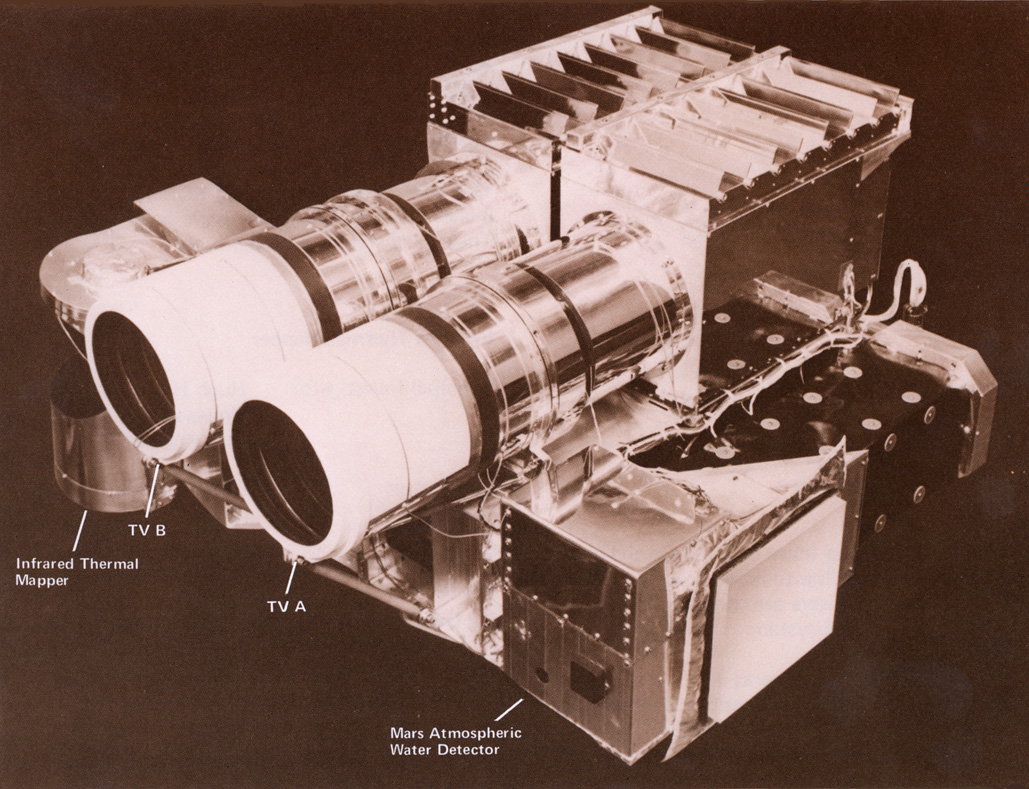
The Viking visual imaging subsystem (VIS) consisted of twin high-resolution, slow-scan television framing cameras mounted on the scan platform of each orbiter with the optical axes offset by 1.38 deg. The two cameras, including their housing, were 21.8 x 21.8 x 94.0 cm in size and had a mass of 40 kg. Each of the two identical cameras on each orbiter had mechanical shutters; a 475-mm focal length telescope; a 37-mm diameter vidicon, the central section of which was scanned in a raster format of 1056 lines by 1182 samples. A filter wheel between the lens and shutter held six color filter positions: blue (0.35 to 0.53 micrometers), minus-blue (0.48 - 0.70), violet (0.35 - 0.47), green (0.50 - 0.60), red (0.55 - 0.70), and clear (no filter) to restrict the spectral bandpass of an image to limited portions of the near-visual response characteristics. Each field of view was 1.54 deg x 1.69 deg with each picture element (pixel) subtending 25 microradians. This translates to an image area on the surface of roughly 40 x 44 km from an altitude of 1500 km. The slight offset of the optical axes and the alternate shuttering mode of operation (the interval between frames being 4.48 s) provided overlapping, wide-swath coverage of the surface. Exposure duration was adjustable from 0.003 to 2.66 seconds. Each pixel was digitized as a 7-bit number (0 to 127) stored in the onboard tape-recorder, and later transmitted to Earth and converted to an 8-bit number by multiplying by 2. The two cameras were completely redundant, each with its own control, electronics, and power systems.
The VIS had four primary functions: to aid in the selection of landing sites that were both safe and scientifically interesting, to observe large scale features of the landing sites for correlation with lander data from the surface, to observe and map the planet for subsequent study of the geologic features of the planet, and to investigate the atmosphere of Mars. Individual images are identified by picture number (PICNO), which is a unique identifier of the scene. Elements of the PICNO are as follows: the first three digits denote the revolution (REV) during which the image was shuttered; the letter A is Viking Orbiter 1, B is Viking Orbiter 2; and the last two digits are the frame number. Operation of this experiment was terminated on August 7, 1980. The Viking 1 Orbiter camera returned approximately 34,200 images.
Alternate Names
- Two Television Cameras with 17 m Resolution
- VIS
- Viking1Orbiter/VIS
- Visual Imaging Subsystem
- urn:nasa:pds:context:instrument:visa.vo1
- urn:nasa:pds:context:instrument:visb.vo1
Facts in Brief
Mass: 40 kg
Funding Agency
- NASA-Office of Space Science (United States)
Disciplines
- Planetary Science: Atmospheres
- Planetary Science: Geology and Geophysics
Additional Information
Questions and comments about this experiment can be directed to: Dr. David R. Williams
Personnel
| Name | Role | Original Affiliation | |
|---|---|---|---|
| Dr. Michael H. Carr | Team Leader | US Geological Survey | carr@usgs.gov |
| Prof. Ronald Greeley | Team Member | Arizona State University | |
| Dr. Harold Masursky | Team Member | US Geological Survey | |
| Dr. Bradford A. Smith | Team Member | University of Arizona | |
| Dr. Lawrence A. Soderblom | Team Member | US Geological Survey | lsoderblom@usgs.gov |
| Dr. John E. Guest | Team Member | University of London | |
| Dr. William A. Baum | Team Member | Lowell Observatory | |
| Dr. Keith A. Howard | Team Member | US Geological Survey | khoward@usgs.gov |
| Dr. James A. Cutts | Team Member | Science Applications, Inc | james.a.cutts@jpl.nasa.gov |
| Dr. Joseph F. Veverka | Team Member | Cornell University | jfv4@cornell.edu |
| Dr. Karl R. Blasius | Team Member | Science Applications, Inc | |
| Mr. John B. Wellman | Team Member | NASA Jet Propulsion Laboratory | jwellman@mail3.jpl.nasa.gov |
| Dr. Geoffrey S. Briggs | Team Member | NASA Headquarters | gbriggs@mail.arc.nasa.gov |
| Mr. Thomas C. Duxbury | Team Member | NASA Jet Propulsion Laboratory | tduxbury@gmu.edu |
Selected References
- Carr, M. H., et al., Imaging experiment - The Viking Mars Orbiter, Icarus, 16, 17-33, doi:10.1016/0019-1035(72)90134-0, 1972.
- Blasius, K. R., et al., Geology of the Valles Marineris: First analysis of imaging from the Viking 1 Orbiter primary mission, J. Geophys. Res., 82, No. 28, 4067-4091, doi:10.1029/JS082i028p04067, Sept. 1977.
- Ruiz, R. M., et al., IPL processing of the Viking Orbiter images of Mars, J. Geophys. Res., 82, No. 28, 4189-4202, doi:10.1029/JS082i028p04189, Sept. 1977.
- Duxbury, T. C., and J. Veverka, Viking imaging of Phobos and Deimos: An overview of the primary mission, J. Geophys. Res., 82, No. 28, 4203-4211, doi:10.1029/JS082i028p04203, Sept. 1977.
![[USA.gov]](/logo/usagov_logo.gif)
