<?xml version="1.0" encoding="UTF-8"?>
<!DOCTYPE html PUBLIC "-//W3C//DTD XHTML 1.0 Transitional//EN" "http://www.w3.org/TR/xhtml1/DTD/xhtml1-transitional.dtd">
<html xmlns="http://www.w3.org/1999/xhtml"><head><title>NASA - NSSDC - Experiment - Details</title><meta http-equiv="Content-Type" content="text/html; charset=utf-8" />
<meta name="description" content="NSSDC Master Catalog" />
<meta name="keywords" content="NASA, NSSDC, NSSDC Master Catalog, NMC, spacecraft, experiments, datasets, data collections, personnel, space events, lunar maps, planetary maps, new data, updated data, lunar events, planetary events, historical events" />
<meta name="orgcode" content="690.1" />
<meta name="rno" content="Edwin.J.Grayzeck.1" />
<meta name="content-owner" content="Edwin.J.Grayzeck.1" />
<meta name="webmaster" content="Edwin.V.Bell.1" />
<link rel="stylesheet" type="text/css" media="screen" href="/style/everyone.css" />

<style type="text/css" media="screen">
@import url("/style/nasa_style.css");
@import url("/style/jin_style.css");
</style>
<!--
<style type="text/css" media="screen">
@import url("/style/style_iefixes.css");
</style>
-->
<link rel="stylesheet" type="text/css" media="print" href="/style/print.css" />
<link rel="stylesheet" type="text/css" media="print" href="/style/jin_print.css" />
<link rel="stylesheet" type="text/css" media="handheld" href="/style/handheld.css" />
</head><body><div id="paper">


  <div id="nasahead">
    <a href="http://www.nasa.gov/" target="_blank"><img src="/logo/nasa_bigheader_logo.gif" alt="NASA Logo, National Aeronautics and Space Administration" width="288" height="51" vspace="6" /></a>

    <div id="links">
      <ul>
        <li>Tuesday, 21 May 2013</li>
      </ul>
    </div>
  </div>
<div id="contentwrapper"><div id="rightcontent"><div id="headimage"><img height="100" width="530" alt="National Space Science Data Center Header" src="/logo/nssdc_header.jpg"/></div><h1>Low-Energy Charged Particles (LECP)</h1><p><strong>NSSDC ID:</strong> 1977-084A-07<br/><strong>Mission Name:</strong> Voyager 1<br/><strong>Principal Investigator:</strong> Dr. Stamatios M. Krimigis<br/></p><div class="twocol"><div class="urone"><h2>Description</h2><p>
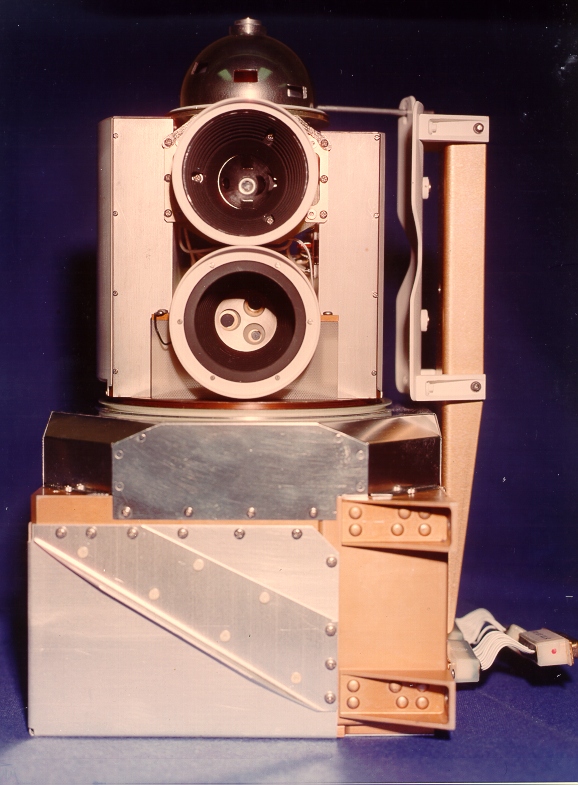
          This experiment was designed to study energetic particles in both planetary and interplanetary environments. In the planetary mode, particle sensing occurred with six different solid-state, totally depleted, surface-barrier type detectors. Both coincidence and singles count data were available from two of the detectors. By looking out at a shallow angle from behind the sun shield, measurements were made in regions where particle fluxes were so high as to saturate low-energy detectors. A current mode option was also available for high flux environments. In the interplanetary mode the experiment was equipped with a particle telescope which had solid-state detectors ranging from 2-2450 micrometers in thickness. The telescope consisted of two multi-dE/dx x E systems placed back to back in order to use a common all solid-state active anticoincidence shield. The telescope allowed the identification of protons, alpha particles, and heavier nuclei (Z from 3 to 26) in the range from 0.05 to 30 MeV. The combined dynamic range of all the instruments extended from approximately 1.E-5 to greater than 1.E12 particles/(sq cm-s-sr). The energy range covered extended from approximately 10 keV to greater than 11 MeV for electrons and from approximately 15 keV to greater than or equal to 150 MeV for protons and heavier ions. A stepping motor rotated the array of detectors through eight discrete sectors in 45-deg increments, thus allowing a 360-deg scan. For a description of the experiment see Space Science Reviews, 1977, v. 21, pp. 329-354.
          </p></div><div class="urtwo"><h2>Alternate Names</h2><ul><li>LECP</li></ul><h2>Facts in Brief</h2><p><strong>Mass:</strong> 7.5 kg<br/><strong>Power (avg):</strong> 3.8 W<br/></p><h2>Funding Agency</h2><ul><li>NASA-Office of Space Science (United States)</li></ul><h2>Disciplines</h2><ul><li>Planetary Science: Fields and Particles</li><li>Space Physics: Heliospheric Studies</li></ul><h2>Additional Information</h2><ul><li><a href="spacecraftDisplay.do?id=1977-084A">Voyager 1</a></li><li><a href="datasetSearch.do?spacecraft=Voyager 1&amp;experiment=Low-Energy Charged Particles (LECP)">Data collections from this experiment</a></li></ul><h2/><p>
          Questions or comments about this experiment can be directed to:
          <a href="mailto:ed.bell@nasa.gov?Subject=NMC Comment/Question: Low-Energy Charged Particles (LECP) (1977-084A-07)">Dr. Edwin V. Bell, II</a>.
          </p></div></div><div class="clear"> </div><h2>Personnel</h2><table cellspacing="0" class="datatab"><thead><tr><th>Name</th><th>Role</th><th>Original Affiliation</th><th>E-mail</th></tr></thead><tbody><tr><td>Dr. Carl O. Bostrom</td><td>Co-Investigator</td><td>Applied Physics Laboratory</td><td> </td></tr><tr class="odd"><td>Prof. George Gloeckler</td><td>Co-Investigator</td><td>University of Maryland</td><td>gg10@umail.umd.edu</td></tr><tr><td>Dr. Louis J. Lanzerotti</td><td>Co-Investigator</td><td>AT&#x26;T Bell Laboratories</td><td>louis.j.lanzerotti@njit.edu</td></tr><tr class="odd"><td>Dr. William Ian Axford</td><td>Co-Investigator</td><td>Victoria University of Wellington</td><td>axford@linmpi.mpg.de</td></tr><tr><td>Dr. Edwin P. Keath</td><td>Co-Investigator</td><td>Applied Physics Laboratory</td><td> </td></tr><tr class="odd"><td>Dr. Charles Y. Fan</td><td>Co-Investigator</td><td>University of Arizona</td><td> </td></tr><tr><td>Dr. Stamatios M. Krimigis</td><td>Principal Investigator</td><td>Applied Physics Laboratory</td><td>tom.krimigis@jhuapl.edu</td></tr><tr class="odd"><td>Dr. Thomas P. Armstrong</td><td>Co-Investigator</td><td>University of Kansas</td><td>armstrong@ftecs.com</td></tr></tbody></table><h2>Selected References</h2><p>Krimigis, S. M., <em>et al.</em>,
      The low energy charged particle (LECP) experiment on the Voyager spacecraft,
      <em>Space Sci. Rev.</em>, 21, No. 3, 329-354, Dec. 1977.
      </p><p>Krimigis, S. M., <em>et al.</em>,
      Characteristics of the hot plasma in the Jovian magnetosphere: Results from the Voyager spacecraft,
      <em>J. Geophys. Res.</em>, 86, No. A10, 8227-8258, Sept. 1981.
      </p><p>Armstrong, T. P., <em>et al.</em>,
      Low-energy charged particle observations in the 5-20 RJ region of the Jovian magnetosphere,
      <em>J. Geophys. Res.</em>, 86, No. A10, 8343-8356, Sept. 1981.
      </p><p>Zwickl, R. D., <em>et al.</em>,
      Energetic particle events greater than or equal to 30 keV of Jovian origin observed by Voyager 1 and 2 in interplanetary space,
      <em>J. Geophys. Res.</em>, 86, No. A10, 8125-8140, Sept. 1981.
      </p><p>Krimigis, S. M., <em>et al.</em>,
      General characteristics of hot plasma and energetic particles in the Saturnian magnetosphere: Results from the Voyager spacecraft,
      <em>J. Geophys. Res.</em>, 88, No. A11, 8871-8892, Nov. 1983.
      </p><p>Armstrong, T. P., <em>et al.</em>,
      Voyager observations of Saturnian ion and electron phase space densities,
      <em>J. Geophys. Res.</em>, 88, No. A11, 8893-8904, Nov. 1983.
      </p><p>Krimigis, S. M., and E. C. Roelof,
      Low-energy particle population,
      In--Physics of the Jovian Magnetosphere, edited by A. J. Dessler, pp. 106--156, Cambridge U. Press, Cambridge, UK, 1983.
      </p></div><div id="leftcontent"><div id="leftnav"><h2>NSSDC Master Catalog Search</h2>
  <ul>
    <li id="lnone"><a href="/nmc/SpacecraftQuery.jsp">Spacecraft</a></li>
    <li id="lntwo"><a href="/nmc/ExperimentQuery.jsp">Experiments</a></li>
    <li id="lnthree"><a href="/nmc/DatasetQuery.jsp">Data Collections</a></li>
    <li id="lnfour"><a href="/nmc/PersonQuery.jsp">Personnel</a></li>
    <li id="lnfive"><a href="/nmc/PublicationQuery.jsp">Publications</a></li>
    <li id="lnsix"><a href="/nmc/MapQuery.jsp">Maps</a></li>
    <li id="lnseven"><a href="/nmc/NewDataQuery.jsp">New/Updated Data</a></li>
    <li id="lneight"><a href="/nmc/EventQuery.jsp">Lunar/Planetary Events</a></li>
  </ul>
</div><div style="width:175px;" class="capleft"><a href="http://nssdc.gsfc.nasa.gov/image/spacecraft/voyager-lecp.jpg"><img height="238" width="175" alt="Image of the Low-Energy Charged Particles (LECP) experiment" src="http://nssdc.gsfc.nasa.gov/thumbnail/spacecraft/voyager-lecp.jpg"/></a><p>Low-Energy Charged Particles (LECP)</p></div></div></div>  <div id="nasafoot">
    <a href="http://www.usa.gov/" target="_blank"><img src="/logo/usagov_logo.gif" width="130" height="34" alt="[USA.gov]" /></a>

    <div id="nasafootplus">
      <ul>
        <li>+ <a href="http://www.nasa.gov/about/highlights/HP_Privacy.html">Privacy Policy and Important Notices</a></li>
      </ul>
    </div>

    <a href="http://www.nasa.gov/" target="_blank"><img id="nasafootr" src="/logo/nasa_logo_small.gif" width="61" height="40" vspace="5" alt="NASA Logo - nasa.gov" /></a>

    <div id="nasafootlinks">
      <ul>
        <li>NASA Official: <a href="mailto:Edwin.J.Grayzeck@nasa.gov">Dr. Ed Grayzeck</a></li>
        <li>Curator: <a href="mailto:Ed.Bell@nasa.gov">E. Bell, II</a></li>
        <li>Version 4.0.21, 27 March 2013</li>
      </ul>
    </div>
  </div>
</div></body></html>