
- Thursday, 02 May 2024

Energetic Particles Detector (EPD)
NSSDCA ID: 1989-084B-06
Mission Name: Galileo OrbiterPrincipal Investigator:Dr. Donald J. Williams
Description
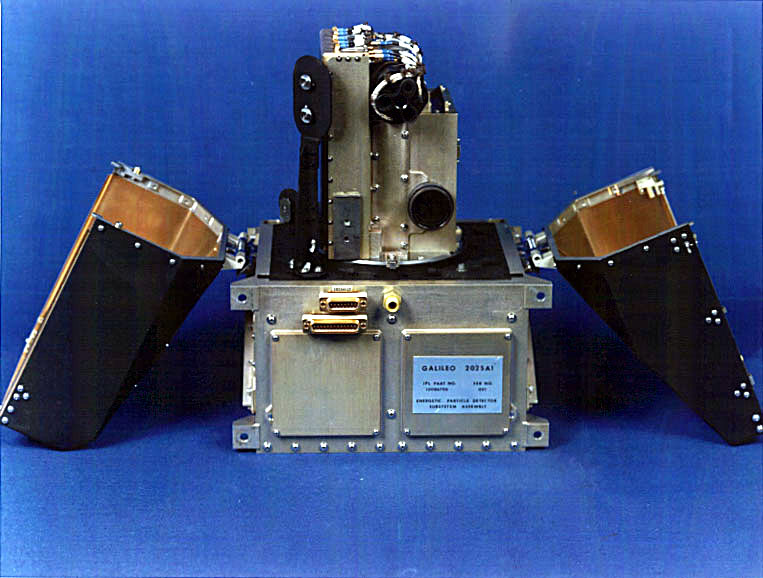
The Energetic Particles Detector (EPD) was designed to: (1) measure the energy and angular distribution, composition, and stability of trapped radiation at Jupiter; (2) study the interaction of these particles with the Galilean satellites and the solar wind; (3) derive thermal plasma flow velocities and temperatures; and, (4) examine adiabatic and non-thermal processes in the trapped radiation.
To achieve these goals, the experiment used two instruments: the Low-Energy Magnetospheric Measurements System (LEMMS) and the Composition Measurements System (CMS). Both instruments were contained in a package with overall dimensions of 19.5 x 27 x 36.1 cm which was mounted on the spun section of the spacecraft. These two bi-directional, solid-state detector telescopes were mounted on a platform which was rotated by a stepper motor into one of eight positions. This rotation of the platform, combined with the spinning of the orbiter in a plane perpendicular to the platform rotation, permitted a 4-pi steradian coverage of incoming particles. The forward (0 degree) ends of the two telescopes had an unobstructed view over the unit sphere or could be positioned behind a shield which not only prevented the entrance of incoming radiation, but contained a source, thus allowing background corrections and in-flight calibrations to be made. The aft (180 degree) ends of the telescopes had portions of their fields-of-view (FOV) blocked in three positions by the magnetometer boom and the shield.
The LEMMS was a double-ended telescope containing eight heavily shielded silicon solid-state surface barrier totally-depleted detectors. The 0 degree end of the LEMMS used magnetic deflection to separate incoming electrons and ions. The 180 degree end used absorbers in combination with the detectors to provide measurements of higher-energy electrons and ions. The LEMMS provided measurements of electrons from 15 keV to greater than 11 MeV and of ions from 22 keV to about 55 MeV in 32 rate channels.
The CMS contained two types of energetic particle telescopes. A small time-of-flight (TOF) telescope was oriented in the 0 degree direction while a pair of delta-E x E solid-state detector telescopes (covering higher energy ranges) were oriented in the opposite direction. The TOF portion of the CMS was modified during the post-Challenger period to permit a lower-energy threshold for composition measurements. The TOF telescope permitted the measurement of H ions from 80 keV-1.25 MeV, He from 27 keV/nucleon-1.0 MeV/nucleon, medium nuclei (O) between 12-522 keV/nucleon, intermediate nuclei (S) between 16-310 keV/nucleon, and heavy nuclei (Fe) between 20-200 keV/nucleon. The delta-E x E telescopes were designed to permit the measurement of Z>=2 ions to higher energies than those attained by the CMS TOF telescope. These instruments measured He (0.19-1.4 MeV/nucleon), medium nuclei (O: 0.16-10.7 MeV/nucleon), intermediate nuclei (Na: 1.0-11.7 MeV/nucleon), and heavy nuclei (Fe: 0.22-15.0 MeV/nucleon). The TOF telescope measured ions in 13 composition channels as did the delta-E x E telescopes.
The LEMMS detectors were capable of handling particle incidence rates up to 600,000 counts/s without requiring significant rate corrections for detector dead time. The CMS electronics were more rate restricted, with the TOF telescope capable of operating at rates well above 150,000 counts/s and the delta-E x E telescopes experiencing problems around 50,000 counts/s.
Alternate Names
- EPD
- GalileoOrbiter/EPD
- urn:nasa:pds:context:instrument:go.epd
Facts in Brief
Mass: 10.5 kg
Power (avg): 10.1 W
Bit rate (avg): 0.912 kbps
Funding Agency
- NASA-Office of Space Science Applications (United States)
Disciplines
- Planetary Science: Fields and Particles
- Space Physics: Heliospheric Studies
Additional Information
Questions and comments about this experiment can be directed to: Dr. Edwin V. Bell, II
Personnel
| Name | Role | Original Affiliation | |
|---|---|---|---|
| Dr. Berend Wilken | Co-Investigator | Max-Planck-Institut fur Aeronomie | |
| Dr. Louis J. Lanzerotti | Co-Investigator | AT&T Bell Laboratories | louis.j.lanzerotti@njit.edu |
| Prof. Juan G. Roederer | Co-Investigator | University of Alaska | jgr@giuaf.gi.alaska.edu |
| Dr. Thomas P. Armstrong | Co-Investigator | University of Kansas | |
| Dr. Stamatios M. Krimigis | Co-Investigator | Applied Physics Laboratory | tom.krimigis@jhuapl.edu |
| Dr. Richard W. McEntire | Co-Investigator | Applied Physics Laboratory | richard.mcentire@jhuapl.edu |
| Dr. Edward C. Roelof | Co-Investigator | Applied Physics Laboratory | edmond.roelof@jhuapl.edu |
| Prof. Theodore Allan Fritz | Co-Investigator | Los Alamos National Laboratory | fritz@bu.edu |
| Dr. Wolfgang Studemann | Co-Investigator | Max-Planck-Institut fur Aeronomie | |
| Dr. Donald J. Williams | General Contact | Applied Physics Laboratory | donald.williams@jhuapl.edu |
| Dr. Donald J. Williams | Principal Investigator | Applied Physics Laboratory | donald.williams@jhuapl.edu |
Selected References
- Williams, D. J., et al., Energetic particles at Venus: Galileo results, Science, 253, No. 5027, 1525-1528, doi:10.1126/science.253.5027.1525, Sep. 1991.
- Williams, D. J., et al., The Galileo energetic particles detector, Space Sci. Rev., 60, No. 1/4, 385-412, doi:10.1007/978-94-011-2512-3_16, May 1992.
![[USA.gov]](/logo/usagov_logo.gif)
