<?xml version="1.0" encoding="UTF-8"?>
<!DOCTYPE html PUBLIC "-//W3C//DTD XHTML 1.0 Transitional//EN" "http://www.w3.org/TR/xhtml1/DTD/xhtml1-transitional.dtd">
<html xmlns="http://www.w3.org/1999/xhtml"><head><title>NASA - NSSDC - Experiment - Details</title><meta http-equiv="Content-Type" content="text/html; charset=utf-8" />
<meta name="description" content="NSSDC Master Catalog" />
<meta name="keywords" content="NASA, NSSDC, NSSDC Master Catalog, NMC, spacecraft, experiments, datasets, data collections, personnel, space events, lunar maps, planetary maps, new data, updated data, lunar events, planetary events, historical events" />
<meta name="orgcode" content="690.1" />
<meta name="rno" content="Edwin.J.Grayzeck.1" />
<meta name="content-owner" content="Edwin.J.Grayzeck.1" />
<meta name="webmaster" content="Edwin.V.Bell.1" />
<link rel="stylesheet" type="text/css" media="screen" href="/style/everyone.css" />

<style type="text/css" media="screen">
@import url("/style/nasa_style.css");
@import url("/style/jin_style.css");
</style>
<!--
<style type="text/css" media="screen">
@import url("/style/style_iefixes.css");
</style>
-->
<link rel="stylesheet" type="text/css" media="print" href="/style/print.css" />
<link rel="stylesheet" type="text/css" media="print" href="/style/jin_print.css" />
<link rel="stylesheet" type="text/css" media="handheld" href="/style/handheld.css" />
</head><body><div id="paper">


  <div id="nasahead">
    <a href="http://www.nasa.gov/" target="_blank"><img src="/logo/nasa_bigheader_logo.gif" alt="NASA Logo, National Aeronautics and Space Administration" width="288" height="51" vspace="6" /></a>

    <div id="links">
      <ul>
        <li>Thursday, 20 June 2013</li>
      </ul>
    </div>
  </div>
<div id="contentwrapper"><div id="rightcontent"><div id="headimage"><img height="100" width="530" alt="National Space Science Data Center Header" src="/logo/nssdc_header.jpg"/></div><h1>Thermal Emission Spectrometer (TES)</h1><p><strong>NSSDC ID:</strong> 1996-062A-02<br/><strong>Mission Name:</strong> Mars Global Surveyor<br/><strong>Principal Investigator:</strong> Prof. Philip R. Christensen<br/></p><div class="twocol"><div class="urone"><h2>Description</h2><p>
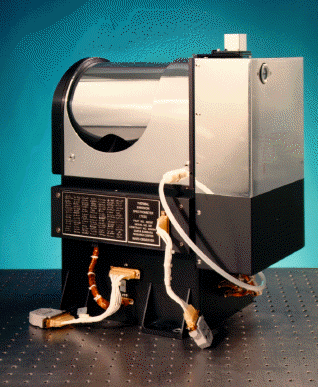
          The Mars Global Surveyor Thermal Emission Spectrometer (TES) is designed to measure the infrared thermal radiation emitted by the martian atmosphere and surface. This information will be used to study: 1) the thermophysical properties of Martian surface materials; 2) the composition and surface distribution of martian rock and soil and, indirectly, the past presence of water on Mars; 3) the growth and contraction of the polar ice caps, as well as the amount of radiation absorbed, reflected, and emitted by the caps and the composition of the ice; 4) the circulation and dynamics of the atmosphere over the course of a martian year, the atmospheric pressure and temperature distribution, and the long-term climate; and 5) the composition and distribution of atmospheric dust and clouds. This information will extend and improve upon measurements of thermal infrared emission instruments carried by earlier missions (Mariners 6, 7, and 9 and Vikings 1 and 2).
</p>
<p>
The TES instrument encompasses three measurement channels: a spectrometer, a bolometer or radiance channel, and a reflectance or albedo channel. The spectrometer is a Michelson interferometer with six fields of view, each with 3 km resolution. The spectrometer measures 143 distinct spectral bands covering a range of 6.25 to 50 micrometers (200/cm to ~1600/cm) at spectral resolutions of 5 and 10/cm. The bolometer (radiance) channel measures broadband thermal infrared radiance from 4.5 to 100 micrometers with a spatial resolution of 3 km. The albedo (reflectance) channel measures broadband visible/near-infrared solar reflectance from 0.3 to 2.7 micrometers, also at 3 km resolution. The detectors are three sets of 2x3 pyroelectric arrays with a pixel size of 8.3 mrad, giving fields of view of 24.9 x 16.6 mrad.
</p>
<p>
The TES is run by an 80C86 microprocessor and a TI digital signal processor (FFT). It contains 0.6 Mbyte RAM for operations and buffering. The available data rates are 688, 1664, and 4992 real-time bits/sec. It can accept commands at approximately 300 words/day as multiple 16 bit words. The peak transient power requirement is 18.2 W.
</p>
<p>
The TES is fixed to one side of the Mars Global Surveyor spacecraft along with the other instruments, pointing directly down towards the surface. A mirror allows views of deep space, nadir, and aft and forward limbs.
          </p></div><div class="urtwo"><h2>Alternate Names</h2><ul><li>TES</li></ul><h2>Facts in Brief</h2><p><strong>Mass:</strong> 14.1 kg<br/><strong>Power (avg):</strong> 13.2 W<br/><strong>Bit rate (avg):</strong> 4.992 bps<br/></p><h2>Funding Agency</h2><ul><li>NASA-Office of Space Science (United States)</li></ul><h2>Disciplines</h2><ul><li>Planetary Science: Atmospheres</li><li>Planetary Science: Geology and Geophysics</li></ul><h2>Additional Information</h2><ul><li><a href="spacecraftDisplay.do?id=1996-062A">Mars Global Surveyor</a></li><li><a href="datasetSearch.do?spacecraft=Mars Global Surveyor&amp;experiment=Thermal Emission Spectrometer (TES)">Data collections from this experiment</a></li></ul><h2/><p>
          Questions or comments about this experiment can be directed to:
          <a href="mailto:David.R.Williams@nasa.gov?Subject=NMC Comment/Question: Thermal Emission Spectrometer (TES) (1996-062A-02)">Dr. David R. Williams</a>.
          </p></div></div><div class="clear"> </div><h2>Personnel</h2><table cellspacing="0" class="datatab"><thead><tr><th>Name</th><th>Role</th><th>Original Affiliation</th><th>E-mail</th></tr></thead><tbody><tr><td>Prof. Philip R. Christensen</td><td>Principal Investigator</td><td>Arizona State University</td><td>phil@elspeth.la.asu.edu</td></tr></tbody></table><h2>Selected References</h2><p>Christensen, P. R., <em>et al.</em>,
      Results from the Mars Global Surveyor Thermal Emission Spectrometer,
      <em>Science</em>, 279, No. 5357, 1692-1698, Mar. 1998.
      </p><p>Christensen, P. R., <em>et al.</em>,
      Mars Global Surveyor Thermal Emission Spectrometer experiment: Investigation description and surface science results,
      <em>J. Geophys. Res.</em>, 106, No. E10, 23823-23871, Oct. 2001.
      </p></div><div id="leftcontent"><div id="leftnav"><h2>NSSDC Master Catalog Search</h2>
  <ul>
    <li id="lnone"><a href="/nmc/SpacecraftQuery.jsp">Spacecraft</a></li>
    <li id="lntwo"><a href="/nmc/ExperimentQuery.jsp">Experiments</a></li>
    <li id="lnthree"><a href="/nmc/DatasetQuery.jsp">Data Collections</a></li>
    <li id="lnfour"><a href="/nmc/PersonQuery.jsp">Personnel</a></li>
    <li id="lnfive"><a href="/nmc/PublicationQuery.jsp">Publications</a></li>
    <li id="lnsix"><a href="/nmc/MapQuery.jsp">Maps</a></li>
    <li id="lnseven"><a href="/nmc/NewDataQuery.jsp">New/Updated Data</a></li>
    <li id="lneight"><a href="/nmc/EventQuery.jsp">Lunar/Planetary Events</a></li>
  </ul>
</div><div style="width:175px;" class="capleft"><a href="http://nssdc.gsfc.nasa.gov/planetary/image/mgs-tes.gif"><img height="213" width="175" alt="Image of the Thermal Emission Spectrometer (TES) experiment" src="http://nssdc.gsfc.nasa.gov/planetary/thumbnail/mgs-tes_sm.gif"/></a><p>Thermal Emission Spectrometer (TES)</p></div></div></div>  <div id="nasafoot">
    <a href="http://www.usa.gov/" target="_blank"><img src="/logo/usagov_logo.gif" width="130" height="34" alt="[USA.gov]" /></a>

    <div id="nasafootplus">
      <ul>
        <li>+ <a href="http://www.nasa.gov/about/highlights/HP_Privacy.html">Privacy Policy and Important Notices</a></li>
      </ul>
    </div>

    <a href="http://www.nasa.gov/" target="_blank"><img id="nasafootr" src="/logo/nasa_logo_small.gif" width="61" height="40" vspace="5" alt="NASA Logo - nasa.gov" /></a>

    <div id="nasafootlinks">
      <ul>
        <li>NASA Official: <a href="mailto:Edwin.J.Grayzeck@nasa.gov">Dr. Ed Grayzeck</a></li>
        <li>Curator: <a href="mailto:Ed.Bell@nasa.gov">E. Bell, II</a></li>
        <li>Version 4.0.24, 14 June 2013</li>
      </ul>
    </div>
  </div>
</div></body></html>