
- Monday, 15 July 2024

Pioneer 1
NSSDCA/COSPAR ID: 1958-007A
Description
Pioneer 1, the second and most successful of three project Able space probes and the first spacecraft launched by the newly formed NASA, was intended to study the ionizing radiation, cosmic rays, magnetic fields, and micrometeorites in the vicinity of the Earth and in lunar orbit. Due to a launch vehicle malfunction, the spacecraft attained only a ballistic trajectory and never reached the Moon. It did return data on the near-Earth space environment.
Spacecraft and Subsystems
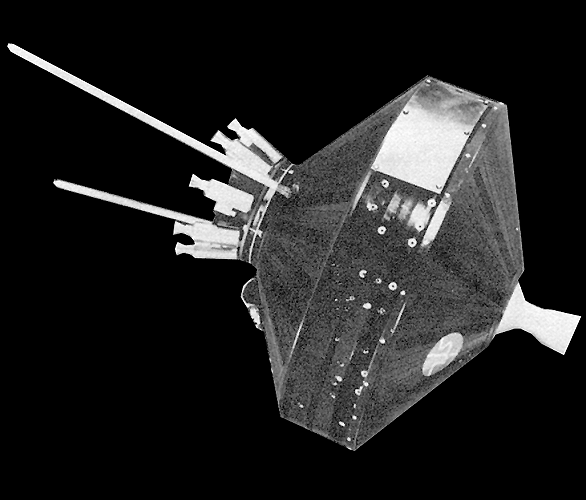
Pioneer 1 consisted of a thin cylindrical midsection with a squat truncated cone frustrum on each side. The cylinder was 74 cm in diameter and the height from the top of one cone to the top of the opposite cone was 76 cm. Along the axis of the spacecraft and protruding from the end of the lower cone was an 11 kg solid propellant injection rocket and rocket case, which formed the main structural member of the spacecraft. Eight small low-thrust solid propellant velocity adjustment rockets were mounted on the end of the upper cone in a ring assembly which could be jettisoned after use. A magnetic dipole antenna also protruded from the top of the upper cone. The shell was composed of laminated plastic. The total mass of the spacecraft after vernier separation was 34.2 kg, after injection rocket firing it would have been 23.2 kg.
The scientific instrument package had a mass of 17.8 kg and consisted of an image scanning infrared television system to study the Moon's surface to a resolution of 1 milliradian, an ionization chamber to measure radiation in space, a diaphragm/microphone assembly to detect micrometeorites, a spin-coil magnetometer to measure magnetic fields to 5 microgauss, and temperature-variable resistors to record spacecraft internal conditions. The spacecraft was powered by nickel-cadmium batteries for ignition of the rockets, silver cell batteries for the television system, and mercury batteries for the remaining circuits. Radio transmission was at on 108.06 MHz through an electric dipole antenna for telemetry and doppler information at 300 mW and a magnetic dipole antenna for the television system at 50 W. Ground commands were received through the electric dipole antenna at 115 MHz. The spacecraft was spin stabilized at 1.8 rps, the spin direction was approximately perpendicular to the geomagnetic meridian planes of the trajectory.
Mission Profile
The spacecraft did not reach the Moon as planned due to an incorrectly set valve in the upper stage which caused an accelerometer to give faulty information leading to a slight error in burnout velocity (the Thor second stage shut down 10 seconds early) and angle (3.5 degrees). This resulted in a ballistic trajectory with a peak altitude of 113,800 km around 1300 local time. The real-time transmission was obtained for about 75% of the flight, but the percentage of data recorded for each experiment was variable. Except for the first hour of flight, the signal to noise ratio was good. The spacecraft ended transmission when it reentered the Earth's atmosphere after 43 hours of flight on October 13, 1958 at 03:46 UT over the South Pacific Ocean. A small quantity of useful scientific information was returned, showing the radiation surrounding Earth was in the form of bands and measuring the extent of the bands, mapping the total ionizing flux, making the first observations of hydromagnetic oscillations of the magnetic field, and taking the first measurements of the density of micrometeorites and the interplanetary magnetic field.
Alternate Names
- 00110
- 1958 Eta 1
- Able 2
- Pioneer1
Facts in Brief
Launch Date: 1958-10-11
Launch Vehicle: Thor-Able
Launch Site: Cape Canaveral, United States
Mass: 34.2 kg
Funding Agencies
- Department of Defense-Department of the Air Force (United States)
- NASA-Office of Space Science Applications (United States)
Disciplines
- Planetary Science
- Space Physics
Additional Information
Questions and comments about this spacecraft can be directed to: Dr. David R. Williams
Personnel
| Name | Role | Original Affiliation | |
|---|---|---|---|
| Mr. Charles F. Hall | Project Manager | NASA Ames Research Center |
Selected References
- Nineteen fifty-eight NASA/USAF space probes (Able-1) - volume 1, 2 and 3, Space Technol. Lab., Inc., Unnumbered, Redondo Beach, Calif., Jun. 1959.
- First deep space probe, IGY Bull., No. 18, 14-15, Dec. 1958.
- Reiff, G. A., Pioneer spacecraft program, Joint Natl. Meet. Am. Astronaut. Soc., (15th Annu.) Oper. Res. Soc. (35th Natl.), AAS. Paper 69-066, Denver, CO, June 1969.
- Sonett, C. P., et al., Surveys of the distant geomagnetic field - Pioneer 1 and Explorer 6, in IGY Sat. Rept. No. 14, 107-123, Wash., DC, July 1961.
![[USA.gov]](/logo/usagov_logo.gif)
