<?xml version="1.0" encoding="UTF-8"?>
<!DOCTYPE html PUBLIC "-//W3C//DTD XHTML 1.0 Transitional//EN" "http://www.w3.org/TR/xhtml1/DTD/xhtml1-transitional.dtd">
<html xmlns="http://www.w3.org/1999/xhtml"><head><title>NASA - NSSDC - Spacecraft - Details</title><meta http-equiv="Content-Type" content="text/html; charset=utf-8" />
<meta name="description" content="NSSDC Master Catalog" />
<meta name="keywords" content="NASA, NSSDC, NSSDC Master Catalog, NMC, spacecraft, experiments, datasets, data collections, personnel, space events, lunar maps, planetary maps, new data, updated data, lunar events, planetary events, historical events" />
<meta name="orgcode" content="690.1" />
<meta name="rno" content="Edwin.J.Grayzeck.1" />
<meta name="content-owner" content="Edwin.J.Grayzeck.1" />
<meta name="webmaster" content="Edwin.V.Bell.1" />
<link rel="stylesheet" type="text/css" media="screen" href="/style/everyone.css" />

<style type="text/css" media="screen">
@import url("/style/nasa_style.css");
@import url("/style/jin_style.css");
</style>
<!--
<style type="text/css" media="screen">
@import url("/style/style_iefixes.css");
</style>
-->
<link rel="stylesheet" type="text/css" media="print" href="/style/print.css" />
<link rel="stylesheet" type="text/css" media="print" href="/style/jin_print.css" />
<link rel="stylesheet" type="text/css" media="handheld" href="/style/handheld.css" />
</head><body><div id="paper">


  <div id="nasahead">
    <a href="http://www.nasa.gov/" target="_blank"><img src="/logo/nasa_bigheader_logo.gif" alt="NASA Logo, National Aeronautics and Space Administration" width="288" height="51" vspace="6" /></a>

    <div id="links">
      <ul>
        <li>Wednesday, 19 June 2013</li>
      </ul>
    </div>
  </div>
<div id="contentwrapper"><div id="rightcontent"><div id="headimage"><img height="100" width="530" alt="National Space Science Data Center Header" src="/logo/nssdc_header.jpg"/></div><h1>Pioneer  3</h1><p><strong>NSSDC/COSPAR ID:</strong> 1958-008A</p><div class="twocol"><div class="urone"><h2>Description</h2><p>
          Pioneer 3 was a spin stabilized spacecraft launched by the U.S. Army Ballistic Missile agency in conjunction with NASA. The spacecraft failed to go past the Moon and into a heliocentric orbit as planned, but did reach a maximum altitude of over 102,000 km before falling back to Earth. The revised spacecraft objectives were to measure radiation in the outer Van Allen belt area using Geiger-Mueller tubes and to test the trigger mechanism for a lunar photographic experiment.
</p>
<h4>Spacecraft and Subsystems</h4>
<p>
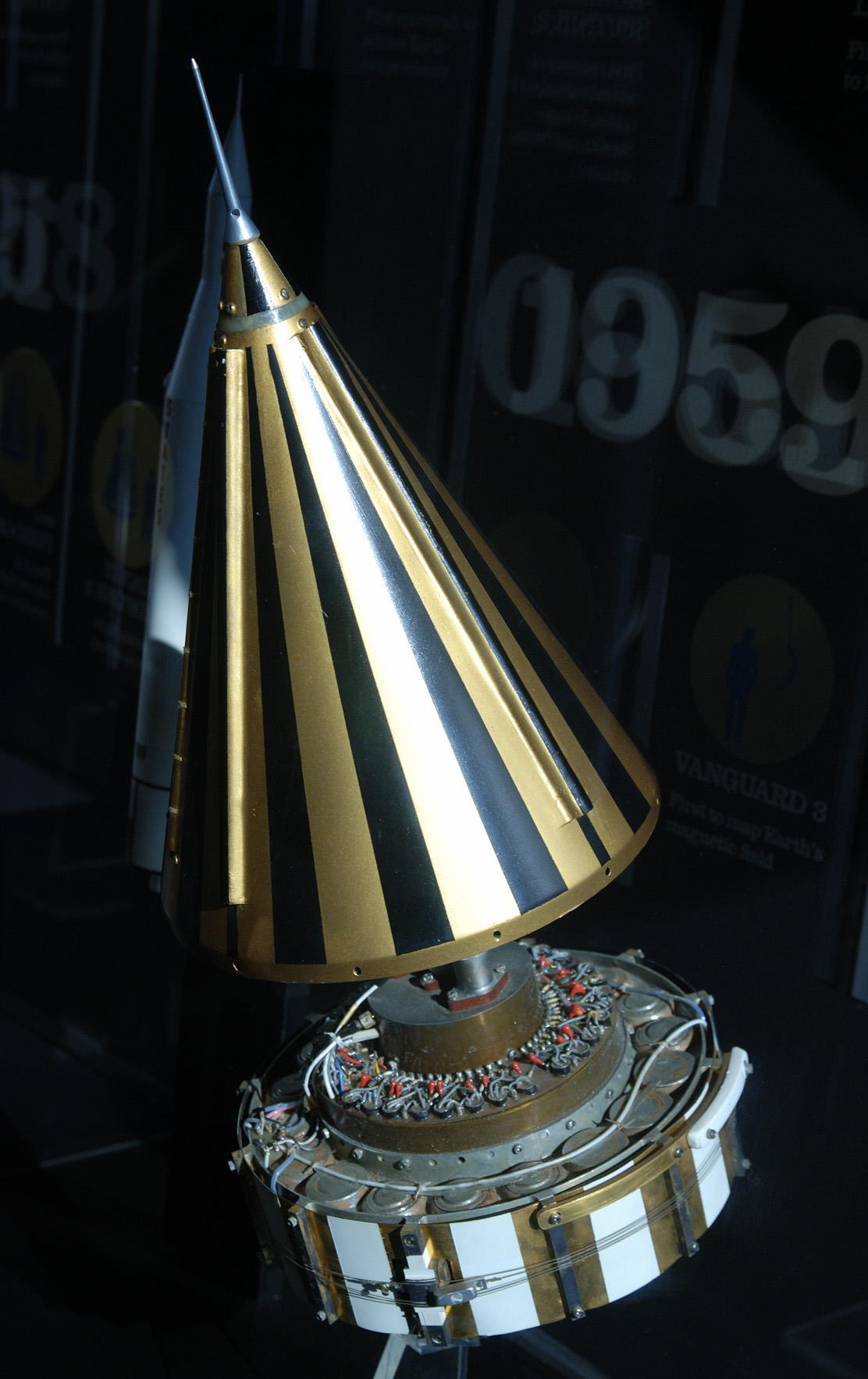
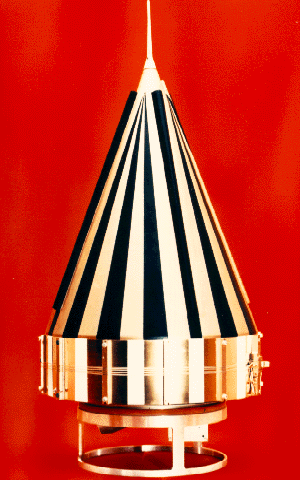
Pioneer 3 was a cone-shaped probe 58 cm high and 25 cm diameter at its base. The cone was composed of a thin fiberglass shell coated with a gold wash to make it electrically conducting and painted with white stripes to maintain the temperature between 10 and 50 degrees C. At the tip of the cone was a small probe which combined with the cone itself to act as an antenna. At the base of the cone a ring of mercury batteries provided power. A photoelectric sensor protruded from the center of the ring. The sensor was designed with two photocells which would be triggered by the light of the Moon when the probe was within about 30,000 km of the Moon. At the center of the cone was a voltage supply tube and two Geiger-Mueller tubes. A transmitter with a mass of 0.5 kg delivered a phase-modulated signal of 0.1 W at a frequency of 960.05 MHz. The modulated carrier power was 0.08 W and the total effective radiated power 0.18 W. A despin mechanism consisted of two 7 gram weights which could be spooled out to the end of two 150 cm wires when triggered by a hydraulic timer 10 hours after launch. The weights would slow the spacecraft spin from 400 rpm to 6 rpm and then weights and wires would be released.
</p>
<h4>Mission Profile</h4>
<p>
The flight plan called for the Pioneer 3 probe to pass close to the Moon after 33.75 hours and then go into solar orbit. However, depletion of propellant caused the first stage engine to shut down 3.7 seconds early preventing the spacecraft from reaching escape velocity. The injection angle was also about 71 degrees instead of the planned 68 degrees. The spacecraft reached an altitude of 102,360 km (109,740 km from the center of the Earth) before falling back to Earth. It re-entered Earth's atmosphere and burned up over Africa on 7 December at approximately 19:51 UT (2:51 p.m. EST) at an estimated location of 16.4 N, 18.6 E. The probe returned telemetry for about 25 hours of its 38 hour 6 minute journey. The other 13 hours were blackout periods due to the location of the two tracking stations. The returned information showed that the internal temperature remained at about 43 degrees C over most of the period. The data obtained were of particular value since they indicated the existence of two distinct radiation belts.
          </p></div><div class="urtwo"><h2>Alternate Names</h2><ul><li>00111</li></ul><h2>Facts in Brief</h2><p><strong>Launch Date:</strong> 1958-12-06<br/><strong>Launch Vehicle:</strong> Juno 2 (Juno II)<br/><strong>Launch Site:</strong> Cape Canaveral, United States<br/><strong>Mass:</strong> 5.87 kg<br/></p><h2>Funding Agencies</h2><ul><li>Department of Defense-Department of the Army (United States)</li><li>NASA-Office of Space Science Applications (United States)</li></ul><h2>Disciplines</h2><ul><li>Planetary Science</li><li>Space Physics</li></ul><h2>Additional Information</h2><ul><li><a href="spacecraftOrbit.do?id=1958-008A">Launch/Orbital information for Pioneer  3</a></li></ul><ul><li><a href="experimentSearch.do?spacecraft=Pioneer  3">Experiments on Pioneer  3</a></li><li><a href="datasetSearch.do?spacecraft=Pioneer  3">Data collections from Pioneer  3</a></li></ul><h2/><p>
          Questions or comments about this spacecraft can be directed to:
          <a href="mailto:David.R.Williams@nasa.gov?Subject=NMC Comment/Question: Pioneer  3 (1958-008A)">Dr. David R. Williams</a>.
          </p></div></div><div class="clear"> </div><h2>Selected References</h2><p>Reiff, G. A.,
      Pioneer spacecraft program,
      Joint Natl. Meet. Am. Astronaut. Soc., (15th Annu.) Oper. Res. Soc. (35th Natl.), AAS. Paper 69-066, Denver, CO, June 1969.
      </p><p>Eimer, M., <em>et al.</em>,
      Tracking the moon probes,
      Space Res., 518-531, 1960. (Proc. 1st Intern. Space Sci. Symp., Nice, France, Jan. 11-16, 1960).
      </p><p>Clark, E.,
      Radiation belt explored by Army's Pioneer III probe,
      <em>Space Technol.</em>, 2, No. 1, 6-9, Jan. 1959.
      </p></div><div id="leftcontent"><div id="leftnav"><h2>NSSDC Master Catalog Search</h2>
  <ul>
    <li id="lnone"><a href="/nmc/SpacecraftQuery.jsp">Spacecraft</a></li>
    <li id="lntwo"><a href="/nmc/ExperimentQuery.jsp">Experiments</a></li>
    <li id="lnthree"><a href="/nmc/DatasetQuery.jsp">Data Collections</a></li>
    <li id="lnfour"><a href="/nmc/PersonQuery.jsp">Personnel</a></li>
    <li id="lnfive"><a href="/nmc/PublicationQuery.jsp">Publications</a></li>
    <li id="lnsix"><a href="/nmc/MapQuery.jsp">Maps</a></li>
    <li id="lnseven"><a href="/nmc/NewDataQuery.jsp">New/Updated Data</a></li>
    <li id="lneight"><a href="/nmc/EventQuery.jsp">Lunar/Planetary Events</a></li>
  </ul>
</div><div style="width:175px;" class="capleft"><a href="http://nssdc.gsfc.nasa.gov/image/spacecraft/pioneer_3_4.gif"><img height="280" width="175" alt="Image of the Pioneer  3 spacecraft" src="http://nssdc.gsfc.nasa.gov/thumbnail/spacecraft/pioneer_3_4.gif"/></a><p>Pioneer  3</p></div></div></div>  <div id="nasafoot">
    <a href="http://www.usa.gov/" target="_blank"><img src="/logo/usagov_logo.gif" width="130" height="34" alt="[USA.gov]" /></a>

    <div id="nasafootplus">
      <ul>
        <li>+ <a href="http://www.nasa.gov/about/highlights/HP_Privacy.html">Privacy Policy and Important Notices</a></li>
      </ul>
    </div>

    <a href="http://www.nasa.gov/" target="_blank"><img id="nasafootr" src="/logo/nasa_logo_small.gif" width="61" height="40" vspace="5" alt="NASA Logo - nasa.gov" /></a>

    <div id="nasafootlinks">
      <ul>
        <li>NASA Official: <a href="mailto:Edwin.J.Grayzeck@nasa.gov">Dr. Ed Grayzeck</a></li>
        <li>Curator: <a href="mailto:Ed.Bell@nasa.gov">E. Bell, II</a></li>
        <li>Version 4.0.24, 14 June 2013</li>
      </ul>
    </div>
  </div>
</div></body></html>