
- Monday, 15 July 2024

Zond 2
NSSDCA/COSPAR ID: 1964-078C
Description
Zond 2 was an automatic interplanetary station launched from a Tyazheliy Sputnik (1964-078A) in Earth parking orbit towards Mars to test space-borne systems and to carry out scientific investigations. The probe carried a descent craft and the same instruments as the Mars 1 flyby spacecraft: a magnetometer probe, television photographic equipment, a spectroreflectometer, radiation sensors (gas-discharge and scintillation counters), charged particle traps, a spectrograph to study ozone absorption bands, and a micrometeoroid instrument.
Spacecraft and Subsystems
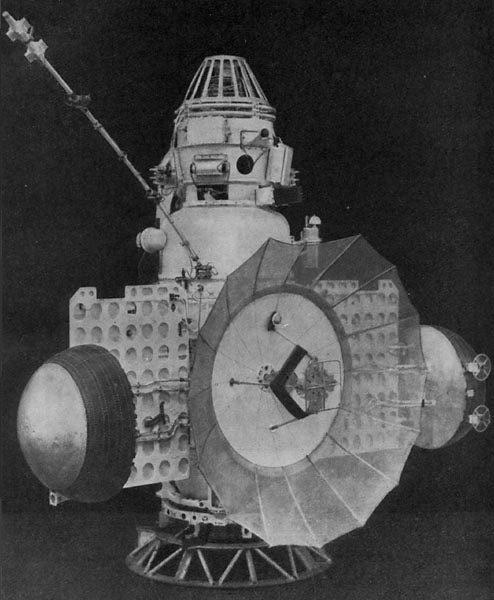
The Zond 2 station consisted of two hermetically sealed modules, the orbital module and the special module. Mounted on the orbital module were a large parabolic dish antenna for tranmissions, a broad beam receiving antenna, solar panels, hemispherical radiators for thermal control, trajectory correction engines, compressed nitrogen bottles, gas-reaction orientation system engines, optical sensors for the orientation system, and scientific sensors. Housed within the orbital module were the gyroscopes and command, control, orientation, and correction systems, batteries, timers, radio telemetry system, thermal regulation internal heat exchangers, and some scientific equipment. The special module held the radio system, batteries, and the scientific instrument payload. The spacecraft had six experimental low-thrust electrojet plasma ion engines that served as actuators of the attitude control system and could be used instead of the gas engines to maintain orientation. Power was provided by the two solar panels.
Mission Profile
Zond 2 was launched on 30 November 1964 into a 153 x 219 km Earth parking orbit and then took a long curving trajectory towards Mars to minimize the relative velocity. The electronic ion engines were successfully tested shortly after launch under real space environment conditions over the period 08-18 December 1964, the first successful firing of ion engines on an interplanetary mission. One of the two solar panels failed due to a broken tug cord, so only half the anticipated power was available to the spacecraft. Controllers were able to finally get the second solar panel to open on 15 December 1964 by firing the plasma engines to shake it free, but this was too late for the crucial first mid-course maneuver. After a putative (but unconfirmed) mid-course maneuver on 17 February 1965, communications with the spacecraft were lost in early May, 1965. The spacecraft flew by Mars on 6 August 1965 at a distance of 1500 km and a relative speed of 5.62 km/s. However, some accounts hold that the communications were lost a month or so after launch and no further contact was made with the spacecraft.
Spacecraft image for illustrative purposes - not necessarily in the public domain.
Alternate Names
- 00945
- 3MV-4 No.2
- Zond2
Facts in Brief
Launch Date: 1964-11-30
Launch Vehicle: Modified SS-6 (Sapwood) with 2nd Generation Upper Stage + Escape Stage
Launch Site: Tyuratam (Baikonur Cosmodrome), U.S.S.R
Mass: 890 kg
Funding Agency
- Unknown (U.S.S.R)
Discipline
- Planetary Science
Additional Information
Questions and comments about this spacecraft can be directed to: Dr. David R. Williams
Personnel
| Name | Role | Original Affiliation |
|---|
Selected References
- Shelton, W., Soviet space exploration - the first decade, Arthur Barker Ltd., Unnumbered, London, England, 1969.
- Harvey, B., The new Russian space programme from competition to collaboration, John Wiley and Sons, Chichester, England, 1996.
- Johnson, N. L., Handbook of soviet lunar and planetary exploration - volume 47 science and technology series, Amer. Astronau. Soc. Publ., 1979.
- Perminov, V. G., The difficult road to Mars - A brief history of Mars exploration in the Soviet Union, NASA, No. 15, Wash, DC, July 1999.
More Information on Mars Exploration
Chronology of Mars Exploration The Difficult Road to Mars - Online Book, 1999 (PDF file) Mars Page![[Mars 1]](http://nssdc.gsfc.nasa.gov/planetary/image/mars-1.jpg)
![[Mars 1]](http://nssdc.gsfc.nasa.gov/planetary/image/mars_1_back.jpg)
Color rendering above is public domain, credit NSSDCA/NASA
![[USA.gov]](/logo/usagov_logo.gif)
