
- Monday, 15 July 2024

Luna 10
NSSDCA/COSPAR ID: 1966-027A
Description
Luna 10 was the first spacecraft to go into orbit around the Moon, and the first human-made object to orbit any body beyond the Earth. The primary objectives were to achieve the first lunar orbit, gain experience in orbital operations, presumably as a precursor to astronaut orbital missions, and study the lunar environment. The launch was timed so that the spacecraft would come around on its first orbit just as the Twenty-third Congress of the Communist Party of the Soviet Union was convening for its morning session.
Spacecraft and Subsystems
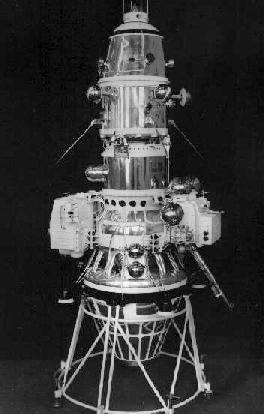
Luna 10 was designated a Ye-6S spacecraft, consisting of a Ye-6 bus with a fueled mass of about 1350 kg attached to a cylindrical pressurized 245 kg lunar orbiter module. The module was probably taken from the Cosmos Earth-orbiting series. It was 1.5 meters tall and 75 cm in diameter at the base. The main propulsion systems for lunar orbit insertion were on the bus, and the science payload was carried on the orbiter module. The payload comprised seven instruments: a gamma-ray spectrometer for energies between 0.3--3 MeV, a triaxial magnetometer (on the end of a 1.5 meter boom), a piezoelectric micrometeoroid detector, gas discharge counters, devices for measuring infrared emissions from the Moon, low energy X-ray detectors, and a bank of charged particle detectors. Additionally, the radio system was used for gravitational and radio occultation studies. Luna 10 was battery powered and communications were via 183 MHz and 922 MHz aerials.
Mission Profile
Following the failure of an identical mission on 1 March 1966 which never left Earth orbit and was designated Cosmos 111, Luna 10 was launched on 31 March 1966 at 10:48 UT. It was injected into a 200 x 250 km, 52 degree Earth orbit and launched towards the Moon from its Earth orbiting platform. Following a mid-course correction on 1 April, Luna 10 turned around at a distance of 8000 km from the Moon and fired its rockets, slowing by 0.64 km/sec. It entered lunar orbit at 18:44 UT on 3 April 1966 and separated from the bus 20 seconds later. The initial orbit was 349 x 1015 km with a period of 2 hours 58 minutes and an inclination of 71.9 degrees. It completed its first orbit on April 4, Moscow time.
The data returned showed a weak to non-existent magnetic field, cosmic radiation of 5 particles/cm2/sec, 198 micrometeoroid impacts, no discernable atmosphere, and a highly distorted gravity field, suggesting a non-uniform mass distribution. The gamma-ray spectrometer gave compositional information on the Moon'ssurface, showing it to be similar to terrestrial basalt. Luna 10 operated for 56 days, covering 460 lunar orbits and 219 active data transmissions before the batteries were depleted and radio signals were discontinued on May 30, 1966. The orbit at that time was 378 x 985 km with an inclination of 72.2 degrees. The orbit would have decayed fairly rapidly, it is assumed that Luna 10 impacted the surface of the Moon sometime in 1966 at an unknown location.
At the Communist Party Congress, the "Internationale" was played over loudspeakers for the assembled 5000 delegates on the morning of 4 April, ostensibly broadcast live from Luna 10 as it rounded the Moon. In fact, it was revealed thirty years later that it was a recording from Luna 10 from the previous night, used because the controllers did not trust a live broadcast and because in a session earlier that morning it was discovered that a note was missing in the transmission from the solid-state oscillators programmed to reproduce the notes of the song.
Spacecraft image for illustrative purposes - not necessarily in the public domain.
Alternate Names
- 02126
- Luna10
- Lunik 10
Facts in Brief
Launch Date: 1966-03-31
Launch Vehicle: Modified SS-6 (Sapwood) with 2nd Generation Upper Stage + Escape Stage
Launch Site: Tyuratam (Baikonur Cosmodrome), U.S.S.R
Mass: 245 kg
Funding Agency
- Unknown (U.S.S.R)
Disciplines
- Planetary Science
- Space Physics
Additional Information
Questions and comments about this spacecraft can be directed to: Dr. David R. Williams
Personnel
| Name | Role | Original Affiliation | |
|---|---|---|---|
| Mr. Artem Ivankov | General Contact | Lavochkin Association | artem.ivankov@laspace.ru |
Selected References
- Dolginov, Sh. Sh., et al., Possible interpretation of results of measurements by the lunar orbiting satellite Luna 10 (in Russian), Geomagn. i Aeron., 7, No. 3, 436-441, 1967.
- Shelton, W., Soviet space exploration - the first decade, Arthur Barker Ltd., Unnumbered, London, England, 1969.
- Johnson, N. L., Handbook of soviet lunar and planetary exploration - volume 47 science and technology series, Amer. Astronau. Soc. Publ., 1979.
- A Tass Communique, In orbit around the Moon first scientific results of the flight of Luna-10, NASA-GSFC, NASA-CR-74202, ST-PR-LPS-10474, Apr. 1966. (Trans. from Pravda, No. 100, 17417, Moscow, Apr. 1966).
![[Luna 10]](http://nssdc.gsfc.nasa.gov/image/spacecraft/luna10_vsm.jpg)
Scale model of Luna 10 on display at Moskva Kosmicheskaya
Courtesy of Alexander Chernov and the Virtual Space Museum
Other Soviet Lunar Missions
Lunar Science Home Page
![[USA.gov]](/logo/usagov_logo.gif)
