
- Wednesday, 17 July 2024

RAE-B
NSSDCA/COSPAR ID: 1973-039A
Description
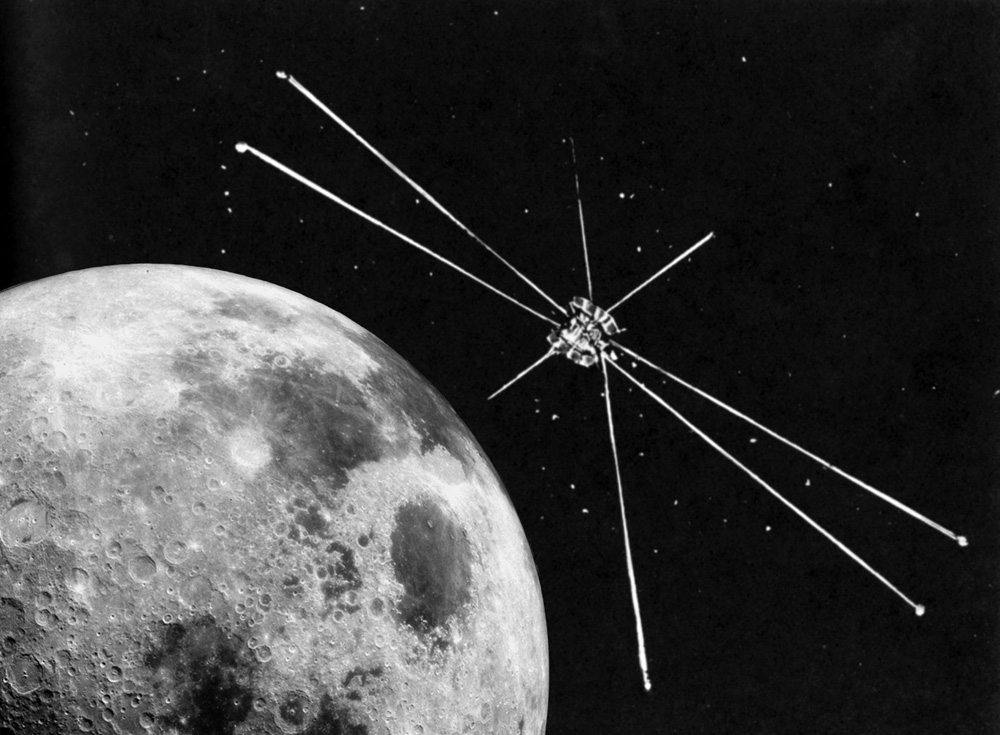
The Radio Astronomy Explorer B (RAE-B) mission was the second of a pair of RAE satellites. It was placed into lunar orbit to provide radio astronomical measurements of the planets, the sun, and the galaxy over the frequency range of 25 kHz to 13.1 MHz. The experiment complement consisted of two Ryle-Vonberg radiometers (nine channels each), three swept-frequency burst receivers (32 channels each), and an impedance probe for calibration. The experiment antenna package, made of BeCu, consisted of very long traveling wave antennas forming an X configuration: a 229-m upper V-antenna pointed away from the Moon; a 229-m lower V-antenna pointed toward the Moon, with a 60 degree angle between the two legs of the "V". Each of the four legs of the two V-antennas was cut one-quarter of the way from its tip and a 600-ohm resistor was inserted. A 37-m dipole antenna ran through the spacecraft parallel to the lunar surface in the same plane as the two V-antennas. There was also a 192-m boron libration damper boom system used to damp out any spacecraft oscillations about the equilibrium position.
The spacecraft body, constructed of aluminum and aluminum honeycomb, had a mass of 328 kg at launch and 200 kg in lunar orbit. It was a truncated cylinder 92 cm in diameter and approximately 79 cm high, with four fixed solar paddles. The solar arrays were n-p solar cells generating 25 W and powering NiCd batteries. The maneuvering system consisted of a hydrazine velocity correction package, a cold gas attitude control system, and a solid fuel lunar insertion motor. Data were returned to Earth via either a low power UHF/(400 MHz) transmitter, in real time, or stored in an onboard tape recorder and transmitted to earth via a high power UHF transmitter (400 MHz). Two tape recorders provided backup storage. A VHF transmitter served primarily for range and range-rate measurements and as a backup. Commands were received on a VHF (148 MHz) receiver, which also was a part of the range and range-rate system. Spacecraft attitude was determined by (1) a solar aspect system, (2) a horizon sensor system, and (3) a panoramic attitude sensor system, and was accurate to 1 deg. The spacecraft was gravity gradient oriented (Z axis parallel to local vertical).
Mission Profile
RAE-B was placed into lunar orbit on 15 June 1973 after a 20 second firing of the solid apogee kickmotor, and began operations on 20 June 1973. Initially only the 37-m dipole antenna was deployed, during which the spacecraft was operated in a 4-rpm spin-stabilized mode with the spin axis in the ecliptic plane normal to the spacecraft-Sun line. After three weeks the dipole booms were retracted, the spacecraft reoriented, the long-V antennas and libration damper were extended, and the dipole was redeployed. The lower V-antenna was initially extended to 183 m during the first 16 months of flight and was extended to its full 229-m length in November 1974. The lunar orbit and position of the Earth as a radio source imposed periodicities on the observations of 29.5 days (the lunar synodic month) and 24.8 hours (the interval between consecutive sweeps of a given Earth geographic position past the Moon. Contact was lost in August 1977, the orbiter presumably crashed some time after this. For additional information, see J. K. Alexander et al., Astron. & Astrophys., v. 40, p. 365, 1975.
Alternate Names
- 06686
- Explorer 49
- PL-693B
- RAE-2
- Radio Astronomy Explorer
Facts in Brief
Launch Date: 1973-06-10
Launch Vehicle: Delta
Launch Site: Cape Canaveral, United States
Mass: 328 kg
Funding Agency
- NASA-Office of Space Science (United States)
Disciplines
- Planetary Science
- Space Physics
- Solar Physics
- Astronomy
Additional Information
Questions and comments about this spacecraft can be directed to: Dr. David R. Williams
Personnel
| Name | Role | Original Affiliation | |
|---|---|---|---|
| Mr. John R. Holtz | Program Manager | NASA Headquarters | |
| Mr. John T. Shea | Project Manager | NASA Goddard Space Flight Center | |
| Dr. Nancy G. Roman | Program Scientist | NASA Headquarters | |
| Dr. Robert G. Stone | Project Scientist | NASA Goddard Space Flight Center | stone@urap.gsfc.nasa.gov |
Selected References
- Weber, R. R., et al., The Radio Astronomy Explorer satellite, a low frequency observatory, NASA-GSFC, TMX-65616, X-693-71-64, Greenbelt, MD, June 1971.
- Radio Astronomy Explorer-B - Goddard's Radio Astronomy Explorer to orbit moon, NASA-GSFC, Unnumbered, Greenbelt, MD, June 1973.
- Groves, R. T., Analysis of the Radio Astronomy Explorer lunar orbit mission, Astrodynamics Conf., Palo Alto, CA, Sept. 11-12, 1972, AIAA and AAS, Paper 72-940, New York, NY, doi:10.2514/6.1972-940, 1972.
- Alexander, J. K., et al., Scientific instrumentation of the Radio-Astronomy-Explorer-2 satellite, Astron. Astrophys., 40, No. 4, 365-371, 1975.
![[USA.gov]](/logo/usagov_logo.gif)
