<?xml version="1.0" encoding="UTF-8"?>
<!DOCTYPE html PUBLIC "-//W3C//DTD XHTML 1.0 Transitional//EN" "http://www.w3.org/TR/xhtml1/DTD/xhtml1-transitional.dtd">
<html xmlns="http://www.w3.org/1999/xhtml"><head><title>NASA - NSSDC - Spacecraft - Details</title><meta http-equiv="Content-Type" content="text/html; charset=utf-8" />
<meta name="description" content="NSSDC Master Catalog" />
<meta name="keywords" content="NASA, NSSDC, NSSDC Master Catalog, NMC, spacecraft, experiments, datasets, data collections, personnel, space events, lunar maps, planetary maps, new data, updated data, lunar events, planetary events, historical events" />
<meta name="orgcode" content="690.1" />
<meta name="rno" content="Edwin.J.Grayzeck.1" />
<meta name="content-owner" content="Edwin.J.Grayzeck.1" />
<meta name="webmaster" content="Edwin.V.Bell.1" />
<link rel="stylesheet" type="text/css" media="screen" href="/style/everyone.css" />

<style type="text/css" media="screen">
@import url("/style/nasa_style.css");
@import url("/style/jin_style.css");
</style>
<!--
<style type="text/css" media="screen">
@import url("/style/style_iefixes.css");
</style>
-->
<link rel="stylesheet" type="text/css" media="print" href="/style/print.css" />
<link rel="stylesheet" type="text/css" media="print" href="/style/jin_print.css" />
<link rel="stylesheet" type="text/css" media="handheld" href="/style/handheld.css" />
</head><body><div id="paper">


  <div id="nasahead">
    <a href="http://www.nasa.gov/" target="_blank"><img src="/logo/nasa_bigheader_logo.gif" alt="NASA Logo, National Aeronautics and Space Administration" width="288" height="51" vspace="6" /></a>

    <div id="links">
      <ul>
        <li>Sunday, 19 May 2013</li>
      </ul>
    </div>
  </div>
<div id="contentwrapper"><div id="rightcontent"><div id="headimage"><img height="100" width="530" alt="National Space Science Data Center Header" src="/logo/nssdc_header.jpg"/></div><h1>Helios-A</h1><p><strong>NSSDC/COSPAR ID:</strong> 1974-097A</p><div class="twocol"><div class="urone"><h2>Description</h2><p>
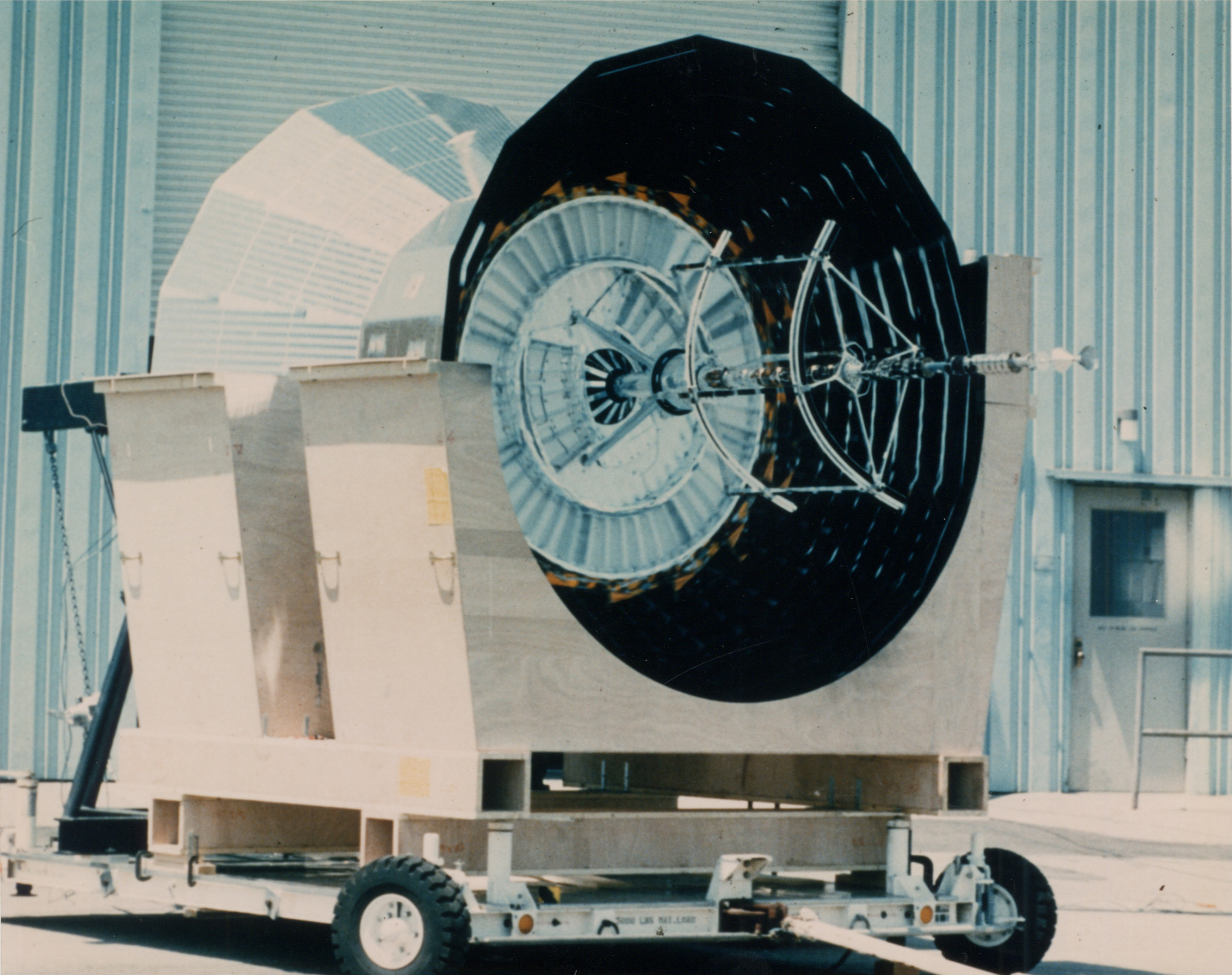
          This spacecraft was one of a pair of deep space probes developed by the Federal Republic of Germany (FRG) in a cooperative program with NASA. Experiments were provided by scientists from both FRG and the U.S. NASA supplied the Titan/Centaur launch vehicle. The spacecraft was equipped with two booms and a 32-m electric dipole. The payload consisted of a fluxgate magnetometer; electric and magnetic wave experiments, which covered various bands in the frequency range 6 Hz to 3 MHz; charged-particle experiments, which covered various energy ranges starting with solar wind thermal energies and extending to 1 GeV; a zodiacal-light experiment; and a micrometeoroid experiment. The purpose of the mission was to make pioneering measurements of the interplanetary medium from the vicinity of the earth's orbit to 0.3 AU. The spin axis was normal to the ecliptic, and the nominal spin rate was 1 rps. The outer spacecraft surface was dielectric, effectively (because of the sheath potential) raising the low-energy threshold for the solar wind plasma experiment to as high as 100 eV. Also, sheath-related coupling caused by the spacecraft antennae produced interference with the wave experiments. The spacecraft was capable of being operated at bit rates from 4096 to 8 bps, variable by factors of 2. While the spacecraft was moving to perihelion, it was generally operated from 64 to 256 bps; and near 0.3 AU, it was operated at the highest bit rate. Because of a deployment failure of one axis of the 32-m, tip-to-tip, dipole antenna, one axis was shorted, causing the antenna to function as a monopole. The major effect of this anomaly was to increase the effective instrument thresholds, and to introduce additional uncertainties in the effective antenna length. Instrument descriptions written by the experimenters were published (some in German, some in English) in Raumfahrtforschung, v. 19, n. 5, 1975.
          </p></div><div class="urtwo"><h2>Alternate Names</h2><ul><li>Helios 1</li><li>07567</li></ul><h2>Facts in Brief</h2><p><strong>Launch Date:</strong> 1974-12-10<br/><strong>Launch Vehicle:</strong> Titan IIIE-Centaur<br/><strong>Launch Site:</strong> Cape Canaveral, United States<br/><strong>Mass:</strong> 371.2 kg<br/></p><h2>Funding Agencies</h2><ul><li>NASA-Office of Space Science Applications (United States)</li><li>Bundesministerium fuer Wissenschaftliche Forschung (Federal Republic of Germany)</li></ul><h2>Disciplines</h2><ul><li>Astronomy</li><li>Planetary Science</li><li>Solar Physics</li><li>Space Physics</li></ul><h2>Additional Information</h2><ul><li><a href="spacecraftOrbit.do?id=1974-097A">Launch/Orbital information for Helios-A</a></li></ul><ul><li><a href="experimentSearch.do?spacecraft=Helios-A">Experiments on Helios-A</a></li><li><a href="datasetSearch.do?spacecraft=Helios-A">Data collections from Helios-A</a></li></ul><h2/><p>
          Questions or comments about this spacecraft can be directed to:
          <a href="mailto:Howard.K.Hills@nasa.gov?Subject=NMC Comment/Question: Helios-A (1974-097A)">Dr. H. Kent Hills</a>.
          </p></div></div><div class="clear"> </div><h2>Personnel</h2><table cellspacing="0" class="datatab"><thead><tr><th>Name</th><th>Role</th><th>Original Affiliation</th><th>E-mail</th></tr></thead><tbody><tr><td>Mr. Gilbert W. Ousley, Sr.</td><td>Project Manager</td><td>NASA Goddard Space Flight Center</td><td> </td></tr><tr class="odd"><td>Mr. Ants Kutzer</td><td>Project Manager</td><td>Ges fur Weltraumforschung</td><td> </td></tr><tr><td>Dr. Albert G. Opp</td><td>Program Scientist</td><td>NASA Headquarters</td><td> </td></tr><tr class="odd"><td>Dr. Earl J. Montoya</td><td>Program Manager</td><td>NASA Headquarters</td><td> </td></tr><tr><td>Dr. James H. Trainor</td><td>Project Scientist</td><td>NASA Goddard Space Flight Center</td><td> </td></tr><tr class="odd"><td>Mr. K. Kasmeier</td><td>General Contact</td><td>Bundesministerium fuer Forschung und Technologie</td><td> </td></tr><tr><td>Dr. Herbert Porsche</td><td>Project Scientist</td><td>Deutsche Forschungs-und Versuchsenstalt fuer Luft-und Raumfahrt</td><td> </td></tr></tbody></table><h2>Other Helios Data/Information at NSSDC</h2>

<p>
<a href="http://nssdcftp.gsfc.nasa.gov/spacecraft_data/helios/">Retrieve interplanetary data from NSSDC's anonymous FTP site</a>
</p>

<h2>Other Sources of Helios Data/Information</h2>

<p>
<a href="http://cohoweb.gsfc.nasa.gov/helios/heli.html">Heliocentric Trajectories</a>
</p>

<p>
<a href="http://www.linmpi.mpg.de/projekte/helios/">Helios at MPI Lindau</a>
</p>
</div><div id="leftcontent"><div id="leftnav"><h2>NSSDC Master Catalog Search</h2>
  <ul>
    <li id="lnone"><a href="/nmc/SpacecraftQuery.jsp">Spacecraft</a></li>
    <li id="lntwo"><a href="/nmc/ExperimentQuery.jsp">Experiments</a></li>
    <li id="lnthree"><a href="/nmc/DatasetQuery.jsp">Data Collections</a></li>
    <li id="lnfour"><a href="/nmc/PersonQuery.jsp">Personnel</a></li>
    <li id="lnfive"><a href="/nmc/PublicationQuery.jsp">Publications</a></li>
    <li id="lnsix"><a href="/nmc/MapQuery.jsp">Maps</a></li>
    <li id="lnseven"><a href="/nmc/NewDataQuery.jsp">New/Updated Data</a></li>
    <li id="lneight"><a href="/nmc/EventQuery.jsp">Lunar/Planetary Events</a></li>
  </ul>
</div></div></div>  <div id="nasafoot">
    <a href="http://www.usa.gov/" target="_blank"><img src="/logo/usagov_logo.gif" width="130" height="34" alt="[USA.gov]" /></a>

    <div id="nasafootplus">
      <ul>
        <li>+ <a href="http://www.nasa.gov/about/highlights/HP_Privacy.html">Privacy Policy and Important Notices</a></li>
      </ul>
    </div>

    <a href="http://www.nasa.gov/" target="_blank"><img id="nasafootr" src="/logo/nasa_logo_small.gif" width="61" height="40" vspace="5" alt="NASA Logo - nasa.gov" /></a>

    <div id="nasafootlinks">
      <ul>
        <li>NASA Official: <a href="mailto:Edwin.J.Grayzeck@nasa.gov">Dr. Ed Grayzeck</a></li>
        <li>Curator: <a href="mailto:Ed.Bell@nasa.gov">E. Bell, II</a></li>
        <li>Version 4.0.21, 27 March 2013</li>
      </ul>
    </div>
  </div>
</div></body></html>