<?xml version="1.0" encoding="UTF-8"?>
<!DOCTYPE html PUBLIC "-//W3C//DTD XHTML 1.0 Transitional//EN" "http://www.w3.org/TR/xhtml1/DTD/xhtml1-transitional.dtd">
<html xmlns="http://www.w3.org/1999/xhtml"><head><title>NASA - NSSDC - Spacecraft - Details</title><meta http-equiv="Content-Type" content="text/html; charset=utf-8" />
<meta name="description" content="NSSDC Master Catalog" />
<meta name="keywords" content="NASA, NSSDC, NSSDC Master Catalog, NMC, spacecraft, experiments, datasets, data collections, personnel, space events, lunar maps, planetary maps, new data, updated data, lunar events, planetary events, historical events" />
<meta name="orgcode" content="690.1" />
<meta name="rno" content="Edwin.J.Grayzeck.1" />
<meta name="content-owner" content="Edwin.J.Grayzeck.1" />
<meta name="webmaster" content="Edwin.V.Bell.1" />
<link rel="stylesheet" type="text/css" media="screen" href="/style/everyone.css" />

<style type="text/css" media="screen">
@import url("/style/nasa_style.css");
@import url("/style/jin_style.css");
</style>
<!--
<style type="text/css" media="screen">
@import url("/style/style_iefixes.css");
</style>
-->
<link rel="stylesheet" type="text/css" media="print" href="/style/print.css" />
<link rel="stylesheet" type="text/css" media="print" href="/style/jin_print.css" />
<link rel="stylesheet" type="text/css" media="handheld" href="/style/handheld.css" />
</head><body><div id="paper">


  <div id="nasahead">
    <a href="http://www.nasa.gov/" target="_blank"><img src="/logo/nasa_bigheader_logo.gif" alt="NASA Logo, National Aeronautics and Space Administration" width="288" height="51" vspace="6" /></a>

    <div id="links">
      <ul>
        <li>Sunday, 19 May 2013</li>
      </ul>
    </div>
  </div>
<div id="contentwrapper"><div id="rightcontent"><div id="headimage"><img height="100" width="530" alt="National Space Science Data Center Header" src="/logo/nssdc_header.jpg"/></div><h1>ISEE 2</h1><p><strong>NSSDC/COSPAR ID:</strong> 1977-102B</p><div class="twocol"><div class="urone"><h2>Description</h2><p>
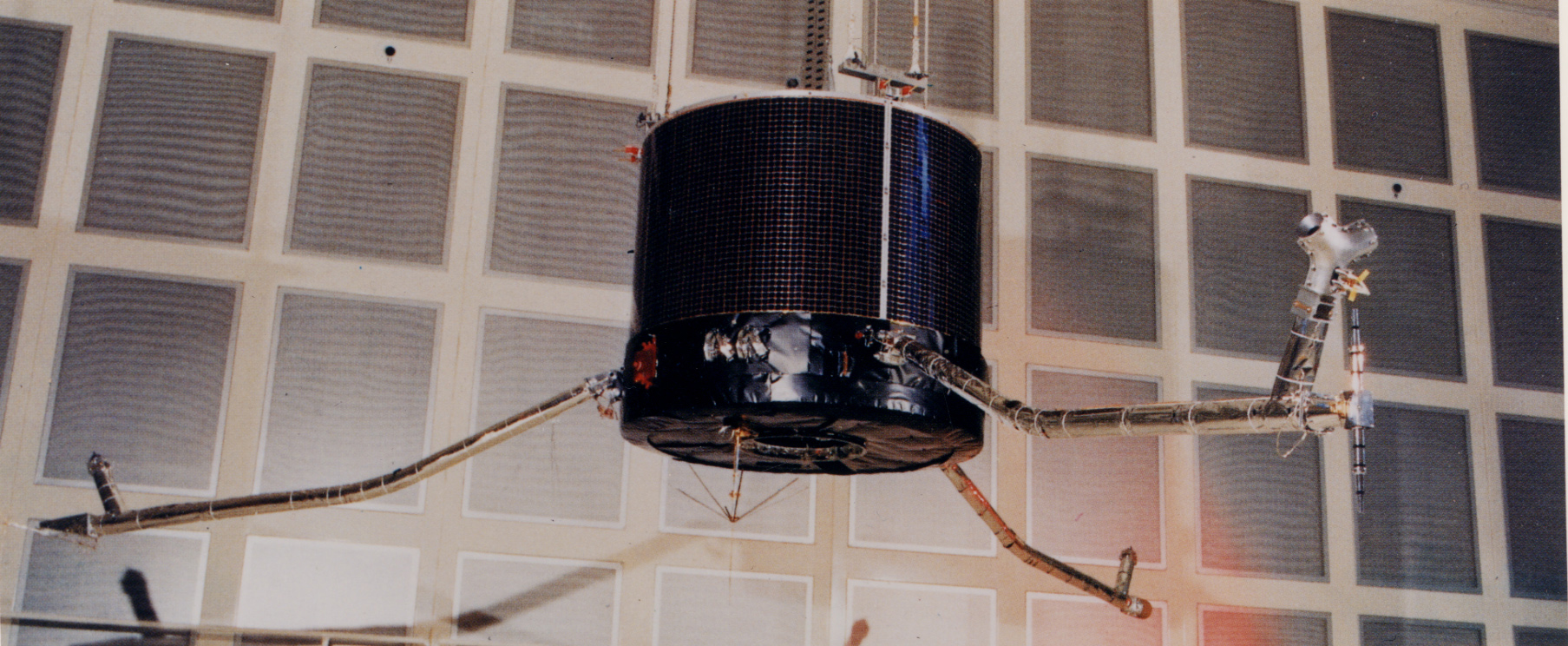
          The Explorer-class daughter spacecraft, International Sun-Earth Explorer 2, was part of the mother/daughter/heliocentric mission (ISEE 1, ISEE 2, ISEE 3). The purposes of the mission were: (1) to investigate solar-terrestrial relationships at the outermost boundaries of the Earth's magnetosphere, (2) to examine in detail the structure of the solar wind near the Earth and the shock wave that forms the interface between the solar wind and the Earth's magnetosphere, (3) to investigate motions of and mechanisms operating in the plasma sheets, and (4) to continue the investigation of cosmic rays and solar flare effects in the interplanetary region near 1 AU. The three spacecraft carried a number of complementary instruments for making measurements of plasmas, energetic particles, waves, and fields. The mission thus extended the investigations of previous IMP spacecraft. The mother/daughter portion of the mission consisted of two spacecraft (ISEE 1 and ISEE 2) with station-keeping capability in the same highly eccentric geocentric orbit with an apogee of 23 Earth radii. During the course of the mission, the ISEE 1 and ISEE 2 orbit parameters underwent short-term and long-term variations due to solar and lunar perturbations. These two spacecraft maintained a small separation distance, and made simultaneous coordinated measurements to permit separation of spatial from temporal irregularities in the near-Earth solar wind, the bow shock, and inside the magnetosphere. By maneuvering ISEE 2, the inter-spacecraft separation as measured near the Earth's bow shock was allowed to vary between 10 km and 5000 km; its value is accurately known as a function of time and orbital position. The spacecraft were spin stabilized, with the spin vectors maintained nominally within 1 degree of perpendicular to the ecliptic plane, pointing north. The spin rates were nominally 19.75 rpm for ISEE 1 and 19.8 rpm for ISEE 2, so that there was a slow differential rotation between the two spacecraft. The ISEE 2 body-mounted solar array supplied approximately 112 watts at launch. The ISEE 2 data rate was 2048 bps most of the time and 8192 bps during one orbit out of every five (with some exceptions). Both ISEE 1 and ISEE 2 re-entered the Earth's atmosphere during orbit 1518 on September 26, 1987. Seventeen of 21 on-board experiments were operational at the end. For instrument descriptions written by the investigators, see IEEE Trans. on Geosci. Electron., v. GE-16, no. 3, July 1978.
          </p></div><div class="urtwo"><h2>Alternate Names</h2><ul><li>International Sun-Earth Explorer-B</li><li>ISEE-B</li><li>10423</li></ul><h2>Facts in Brief</h2><p><strong>Launch Date:</strong> 1977-10-22<br/><strong>Launch Vehicle:</strong> Delta<br/><strong>Launch Site:</strong> Cape Canaveral, United States<br/><strong>Mass:</strong> 165.78 kg<br/><strong>Nominal Power:</strong> 112.0 W
</p><h2>Funding Agencies</h2><ul><li>European Space Agency (International)</li><li>NASA-Office of Space Science Applications (United States)</li></ul><h2>Discipline</h2><ul><li>Space Physics</li></ul><h2>Additional Information</h2><ul><li><a href="spacecraftOrbit.do?id=1977-102B">Launch/Orbital information for ISEE 2</a></li><li><a href="spacecraftPdmp.do?id=1977-102B">PDMP information for ISEE 2</a></li><li><a href="spacecraftTelemetry.do?id=1977-102B">Telecommunications information for ISEE 2</a></li></ul><ul><li><a href="experimentSearch.do?spacecraft=ISEE 2">Experiments on ISEE 2</a></li><li><a href="datasetSearch.do?spacecraft=ISEE 2">Data collections from ISEE 2</a></li></ul><h2/><p>
          Questions or comments about this spacecraft can be directed to:
          <a href="mailto:Howard.K.Hills@nasa.gov?Subject=NMC Comment/Question: ISEE 2 (1977-102B)">Dr. H. Kent Hills</a>.
          </p></div></div><div class="clear"> </div><h2>Personnel</h2><table cellspacing="0" class="datatab"><thead><tr><th>Name</th><th>Role</th><th>Original Affiliation</th><th>E-mail</th></tr></thead><tbody><tr><td>Dr. Alastair C. Durney</td><td>Project Scientist</td><td>ESA-European Space Research and Technology Centre</td><td> </td></tr><tr class="odd"><td>Dr. Keith W. Ogilvie</td><td>Project Scientist</td><td>NASA Goddard Space Flight Center</td><td>keith.w.ogilvie@nasa.gov</td></tr><tr><td>Dr. James B. Willett</td><td>Program Manager</td><td>NASA Headquarters</td><td> </td></tr><tr class="odd"><td>Mr. Paul J. Pashby</td><td>Project Manager</td><td>NASA Goddard Space Flight Center</td><td> </td></tr><tr><td>Mr. Gilbert D. Bullock</td><td>General Contact</td><td>NASA Goddard Space Flight Center</td><td> </td></tr><tr class="odd"><td>Dr. Mary M. Mellott</td><td>Program Scientist</td><td>NASA Headquarters</td><td>mary.m.mellott@nasa.gov</td></tr></tbody></table><h2>Selected References</h2><p>Durney, A. C.,
      Present status of ISEE (A and B) mission,
      In -- Sci. Satell. Prog. During the Intern. Magnetos. Study, Vol. 57, 69-80, D. Reidel Publ. Co., Boston, MA, 1976.
      </p><p>Ogilvie, K. W., <em>et al.</em>,
      Descriptions of experimental investigations and instruments for the ISEE spacecraft,
      IEEE Trans. Geosci. Electron., GE-16, No. 3, 151-153, July 1978.
      </p><p>Durney, A. C., and K. W. Ogilvie,
      Introduction to the ISEE mission,
      <em>Space Sci. Rev.</em>, 22, 679, Sept. 1978.
      </p><p>Ogilvie, K. W., <em>et al.</em>,
      International Sun Earth Explorer - A three spacecraft program,
      <em>Science</em>, 198, No. 4313, 131-138, Oct. 1977.
      </p><p>Durney, A. C.,
      Preliminary results from ISEE-1 and ISEE-2,
      <em>ESA Bull.</em>, No. 16, 23-27, Nov. 1978.
      </p><p>Formisano, V.,
      International Sun Earth Explorer mission - ISEE-2,
      In -- The IMS Source Book, 27-36, C.T. Russell, American Geophysical Union, Wash., DC, 1982.
      </p><h2>Related Missions</h2>

<p>
<a href="/nmc/spacecraftDisplay.do?id=1977-102A">ISEE 1</a><br/>
<a href="/nmc/spacecraftDisplay.do?id=1978-079A">ISEE 3</a>
</p>
</div><div id="leftcontent"><div id="leftnav"><h2>NSSDC Master Catalog Search</h2>
  <ul>
    <li id="lnone"><a href="/nmc/SpacecraftQuery.jsp">Spacecraft</a></li>
    <li id="lntwo"><a href="/nmc/ExperimentQuery.jsp">Experiments</a></li>
    <li id="lnthree"><a href="/nmc/DatasetQuery.jsp">Data Collections</a></li>
    <li id="lnfour"><a href="/nmc/PersonQuery.jsp">Personnel</a></li>
    <li id="lnfive"><a href="/nmc/PublicationQuery.jsp">Publications</a></li>
    <li id="lnsix"><a href="/nmc/MapQuery.jsp">Maps</a></li>
    <li id="lnseven"><a href="/nmc/NewDataQuery.jsp">New/Updated Data</a></li>
    <li id="lneight"><a href="/nmc/EventQuery.jsp">Lunar/Planetary Events</a></li>
  </ul>
</div></div></div>  <div id="nasafoot">
    <a href="http://www.usa.gov/" target="_blank"><img src="/logo/usagov_logo.gif" width="130" height="34" alt="[USA.gov]" /></a>

    <div id="nasafootplus">
      <ul>
        <li>+ <a href="http://www.nasa.gov/about/highlights/HP_Privacy.html">Privacy Policy and Important Notices</a></li>
      </ul>
    </div>

    <a href="http://www.nasa.gov/" target="_blank"><img id="nasafootr" src="/logo/nasa_logo_small.gif" width="61" height="40" vspace="5" alt="NASA Logo - nasa.gov" /></a>

    <div id="nasafootlinks">
      <ul>
        <li>NASA Official: <a href="mailto:Edwin.J.Grayzeck@nasa.gov">Dr. Ed Grayzeck</a></li>
        <li>Curator: <a href="mailto:Ed.Bell@nasa.gov">E. Bell, II</a></li>
        <li>Version 4.0.21, 27 March 2013</li>
      </ul>
    </div>
  </div>
</div></body></html>