
- Tuesday, 16 July 2024

Vega 2 Descent Craft
NSSDCA/COSPAR ID: 1984-128E
Description
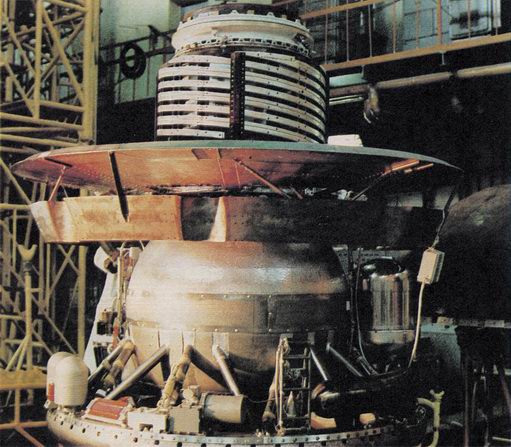
The Vega 2 lander probe was identical to those of Venera 9 through 14 and similarly had two objectives, the study of the atmosphere and the study of the superficial crust. The lander consisted of a hemispherical insulated pressure vessel mounted with shock absorbers on a deformable landing ring. On top of the pressure vessel was a disc-shaped aerobrake which also served as a reflector for the cylindrical fixed communications antenna above it. The lander was held during the cruise to Venus and atmospheric entry in an insulated heat protection sphere 240 cm in diameter, consisting of an upper and lower hemisphere joined nonhermetically.
Instrumentation
In addition to temperature and pressure measuring instruments, the descent probe carried an ISAV UV spectrometer for measurement of minor atmospheric constituents, a VM-4 hygrometer dedicated to measurement of the concentration of H2O, an IPF aerosol analyzer, an ISAV-A particle size spectrometer/nephelometer and other instruments for determination of the chemical composition of the condensed phase: a Sigma 3 gas-phase chromatograph; a BDRP-AM25 X-ray spectrometer observing the fluorescence of grains or drops; and a Malachite mass spectrograph measuring the chemical composition of the grains or drops. The X-ray spectrometer separated the grains according to their sizes using a laser imaging device, while the mass spectrograph separated them according to their sizes using an aerodynamical inertial separator. After landing, a small surface sample near the probe was to be collected by a drilling device and analyzed by a GS-15-SCV gamma ray spectrometer and X-ray fluorescence spectrometer. The UV spectrometer, the mass spectrograph, and the pressure- and temperature-measuring instruments were developed in cooperation between French and Soviet investigators. Data collected by the instruments were transmitted to the Vega 2 spacecraft and relayed to Earth.
Mission Profile
The lander separated from the Vega 2 spacecraft two days before arrival at Venus and entered the planet's atmosphere on an inclined path, without active maneuvers, as was done on previous Venera missions. (The flyby spacecraft was then retargetted using Venus gravity assistance to intercept Comet Halley in March 1986.) After separation from the Vega 2 spacecraft the lander entered the Venus atmosphere on 15 June 1985 at 01:59:30 UT at 10.80 km/s with an entry angle of 19.08 degrees. The pilot parachute was deployed at 02:00:05 UT at an altitude of 65 km and the braking parachute opened 11 seconds later at 64.5 km. The upper heat protection hemisphere was released at this time and the lower hemisphere 4 seconds later at 64.2 km. The upper hemisphere contained the deployment system for the balloon aerostats. The parachute was released at 02:09:15 at 47 km. After this the lander was allowed to aerobrake through the thick Venus atmosphere, with drag devices minimizing vibrations and spin and providing stability. A toroidal system similar to that on Veneras 13 and 14 was designed to absorb shock on landing. The lander touched down at 03:00:50 UT on 15 June 1985 at 8.5 S, 164.5 E, in eastern Aphrodite Terra. The altitude of the touchdown site was 0.1 km above the planetary mean radius. The measured pressure at the landing site was 91 atm and the temperature was 736 K. The surface sample was found to be an anorthosite-troctolite. The balloon measured downward gusts of 1 meter/s and found horizontal winds up to 240 km/hr.
Balloon Aerostats
In addition to the lander probe, a constant-pressure instrumented balloon aerostat was deployed after entry into the atmosphere from the upper heat protection hemisphere at an altitude of 54 km. The balloon released from the hemisphere, deployed a two-stage parachute, and then unfolded and inflated. The 3.4 meter diameter balloon supported a total mass of 25-kg. A 5-kg payload hung suspended 12 meters below the balloon. It floated at approximately 50 km altitude in the middle, most active layer of the Venus three-tiered cloud system. Data from the balloon instruments were transmitted directly to Earth for the 47-hr lifetime of the mission. (The batteries had a lifetime of 60 hrs.) Onboard instruments were to measure temperature, pressure, vertical wind velocity, visibility (density and size of local aerosols), light level and to detect lightning. Very long baseline interferometry was used to track the motion of the balloon to provide the wind velocity in the clouds. The tracking was to be done by a 6-station network on Soviet territory and by a network of 12 stations distributed world-wide (organized by France and the NASA Deep Space Network). After two days the balloon entered the dayside of Venus and expanded and burst due to solar heating.
Image at top of page for illustrative purposes only, not necessarily in the puublic domain.
Alternate Names
- 15856
- Vega 2 Balloon Aerostat
- Vega 2 Lander
- Vega2DescentCraft
Facts in Brief
Launch Date: 1984-12-21
Launch Vehicle: Proton
Launch Site: Tyuratam (Baikonur Cosmodrome), U.S.S.R
Funding Agency
- Soviet Academy of Sciences (U.S.S.R)
Discipline
- Planetary Science
Additional Information
- Launch/Orbital information for Vega 2 Descent Craft
- Telecommunications information for Vega 2 Descent Craft
Questions and comments about this spacecraft can be directed to: Dr. David R. Williams
Personnel
| Name | Role | Original Affiliation |
|---|
Selected References
- Harvey, B., The new Russian space programme from competition to collaboration, John Wiley and Sons, Chichester, England, 1996.
- Surkov, Yu. A., et al., Uranium, thorium, and potassium in the Venusian rocks at the landing sites of Vega 1 and 2, J. Geophys. Res., 92, No. B4, E537-E540, doi:10.1029/JB092iB04p0E537, Mar. 1987.
- Surkov, Yu. A., et al., The water vapor content profile in the Venusian atmosphere according to the results of experiments from Vega 1 and 2, J. Geophys. Res., 91, No. B13, E219-E221, doi:10.1029/JB091iB13p0E219, Nov. 1986.
- Sagdeev, R. Z., and V. I. Moroz, Project Vega first stage: missions to Venus, Sov. Astron. Lett., 12, No. 1, Jan.-Feb. 1986.
![[Vega mission]](http://nssdc.gsfc.nasa.gov/planetary/image/vega_1_2_udvar_hazy.jpg) Vega model on display at the Smithsonian Air and Space Udvar-Hazy Center.
Vega model on display at the Smithsonian Air and Space Udvar-Hazy Center.
Vega 2 Spacecraft
Vega 2 Balloon
Vega 1 Lander
- Information on Vega 2's companion mission
![[Vega mission]](/image/spacecraft/vega-mission.jpg)
![[Vega spacecraft]](/image/spacecraft/vega_atm_probe_vsm.jpg)
Vega mission profile and the Vega atmospheric probe
Vega atmospheric probe model on display at the NPO Lavochkin Museum
(Probe image courtesy of Alexander Chernov and the
Virtual Space Museum)
![[USA.gov]](/logo/usagov_logo.gif)
