
- Monday, 15 July 2024

Ulysses
NSSDCA/COSPAR ID: 1990-090B
Description
The primary objectives of Ulysses, formerly the International Solar Polar Mission (ISPM), are to investigate, as a function of solar latitude, the properties of the solar wind and the interplanetary magnetic field, of galactic cosmic rays and neutral interstellar gas, and to study energetic particle composition and acceleration. The 55 kg payload includes two magnetometers, two solar wind plasma instruments, a unified radio/plasma wave instrument, three energetic charged particle instruments, an interstellar neutral gas sensor, a solar X-ray/cosmic gamma-ray burst detector, and a cosmic dust sensor. The communications systems is also used to study the solar corona and to search for gravitational waves. Secondary objectives included interplanetary and planetary physics investigations during the initial Earth-Jupiter phase and investigations in the Jovian magnetosphere. The spacecraft used a Jupiter swingby in Feb. 1992 to transfer to a heliospheric orbit with high heliocentric inclination, and will pass over the rotational south pole of the sun in mid-1994 at 2 AU, and over the north pole in mid-1995. A second solar orbit will take Ulysses again over the south and north poles in years 2000 and 2001, respectively. The spacecraft is powered by a single radio-isotope generator. It is spin stabilized at a rate of 5 rpm and its high-gain antenna points continuously to the earth. A nutation anomaly after launch was controlled by CONSCAN. The original mission planned for two spacecraft, one built by ESA and the other by NASA. NASA cancelled its spacecraft in 1981.
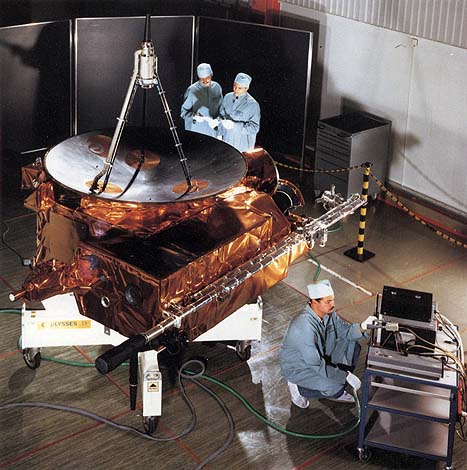
Spacecraft image for illustrative purposes - not necessarily in the public domain.
Alternate Names
- 20842
- ISP
- ISPESA
- ISPM
- ISPM-B
- ISPM/CENTAUR
- International Solar Polar Mission
- Solar Polar
- urn:esa:psa:context:instrument_host:spacecraft.uly
Facts in Brief
Launch Date: 1990-10-06
Launch Vehicle: Shuttle-Centaur G-Prime
Launch Site: Cape Canaveral, United States
Mass: 370 kg
Nominal Power: 285 W
Funding Agencies
- European Space Agency (International)
- NASA-Office of Space Science Applications (United States)
Disciplines
- Planetary Science
- Space Physics
- Solar Physics
- Astronomy
Additional Information
Questions and comments about this spacecraft can be directed to: Dr. John F. Cooper
Personnel
| Name | Role | Original Affiliation | |
|---|---|---|---|
| Dr. Klaus Peter Wenzel | Project Manager | ESA-European Space Research and Technology Centre | kwenzel@estec.esa.nl |
| Mr. Ed B. Massey | Project Manager | NASA Jet Propulsion Laboratory | ed.b.massey@jpl.nasa.gov |
| Dr. Edward J. Smith | Project Scientist | NASA Jet Propulsion Laboratory | edward.j.smith@jpl.nasa.gov |
| Dr. Richard G. Marsden | Project Scientist | ESA-European Space Research and Technology Centre | richard.marsden@esa.int |
Selected References
- Wenzel, K.-P., et al., The International Solar Polar mission--its scientific investigations, ESA SP-1050, Paris, France, July 1983.
- Hawkyard, A., and P. Buia, The Ulysses spacecraft, ESA Bull., No. 63, 40-50, Aug. 1990.
- Caseley, P. J., and R. G. Marsden, The Ulysses scientific payload, ESA Bull., No. 63, 29-38, Aug. 1990.
- Wenzel, K.-P., et al., The Ulysses mission, Astron. Astrophys. Suppl. Ser., 92, No. 2, 207-219, Jan. 1992.
Other Ulysses Data/Information at NSSDCA
COHOWeb (Browse and retrieve Ulysses and other mission data)
CDAWeb (Energetic particle data)
SPDF anonymous FTP site
Heliocentric Trajectories
NSSDCA News article on Ulysses data archiving and access(Dec. 1996)
Ulysses press release on dark matter (05/16/96)
Date Coverage Chart for Ulysses Data Sets at NSSDCA
Related Information/Data at NSSDCA
Other Sources of Ulysses Data/Information
Ulysses Project page(JPL)
Ulysses Project page(ESTEC)
COSPIN home page (U. Chicago)
COSPIN/LET home page (ESTEC)
COSPIN/HET home page (U. Chicago) Access to data
COSPIN/KET home page (IFC/CNR, Milan, Italy)
COSPIN Anisotropy Telescope (Imperial College, UK)
Dust Detector page (MPI-Heidelberg) Access to data
EPAC home page (MPI-Lindau)
GAS home page (MPI-Lindau) Access to data
Gamma Ray Burst home page (UC-Berkeley)
Hi-Scale home page (JHU/APL) Access to data
Hi-Scale home page (Fundamental Tech.) Access to data
SCE home page (U. Bonn) Access to data
SWICS home page (U. Maryland) Access to data
SWOOPS home page (Los Alamos)
URAP home page (NASA Goddard) Access to data
VHM/FGM home page (Imperial College)
![[USA.gov]](/logo/usagov_logo.gif)

