
- Saturday, 27 July 2024

MSX
NSSDCA/COSPAR ID: 1996-024A
Description
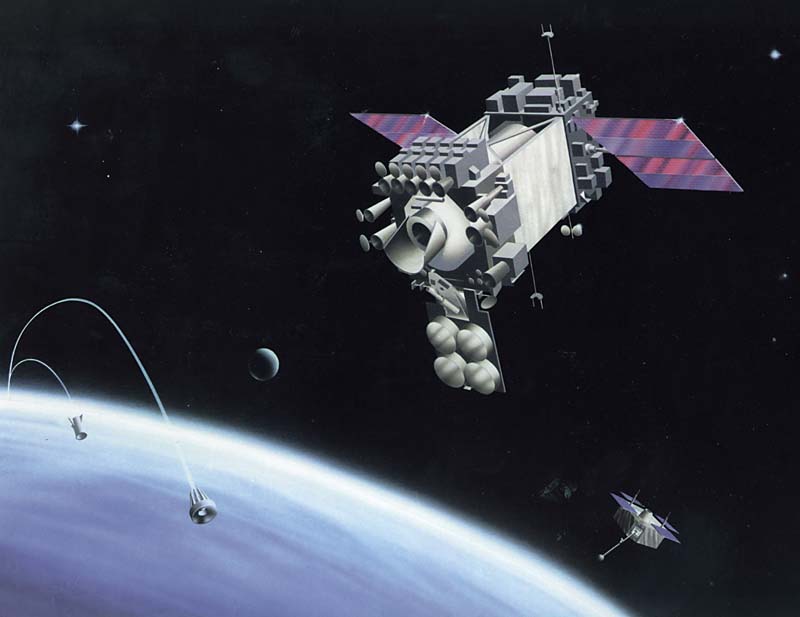
The Midcourse Space Experiment (MSX) was a test project of the Ballistic Missile Defense Organization (BMDO). Its primary purpose was to gather data over a wide-wavelength interval to demonstrate the feasibility of identifying and tracking ballistic missiles during their midcourse flight phase. Its multispectral instruments were capable of obtaining wide band and spectral images in the range of ultraviolet to infrared wavelengths (110 nm to 28,000 nm). The instruments were also utilized for civilian aeronomic and auroral studies.
The 5.1 m spacecraft consisted of three sections each of 1.5 m x 1.5 m cross-section to house three payload components: an electronics section, an 8.5 K frozen hydrogen section, and an instruments section. The three instruments were: SPIRIT III (Space Infrared Imaging Telescope), a five-color, high-spatial resolution scanning radiometer and a six-channel, high-spectral resolution, Fourier-transform spectrometer; UVISI (Ultraviolet and Visible Imagers and Spectrographic Imagers), five spectrographic imagers and four UV/visible imagers with capabilities from the far ultraviolet through visible wavelengths; and, Space-Based Visible (SBV), a visible band telescope with a six-inch aperturn, a charge-coupled device, and image processing electronics. Also on-board were the On-board Signal and Data Processor (OSDP), which provided real-time signal processing for target detection and tracking for data generated by SPIRIT III, sensors for monitoring and measuring instrument contamination and degradation of performance largely due to outgassing, and a number of small (2.0 cm) reference spheres, deployed as reference objects from MSX for instrument calibration.
Alternate Names
- 23851
- Midcourse Space eXperiment
- urn:nasa:pds:context:instrument_host:spacecraft.msx
Facts in Brief
Launch Date: 1996-04-24
Launch Vehicle: Delta II
Launch Site: Vandenberg AFB, United States
Mass: 2700 kg
Nominal Power: 1200 W
Funding Agencies
- Department of Defense-Department of the Navy (United States)
- Air Force Ballistic Missile Defense Organization (United States)
Disciplines
- Planetary Science
- Space Physics
- Engineering
- Astronomy
- Earth Science
Additional Information
Questions and comments about this spacecraft can be directed to: Dr. Dieter K. Bilitza
Personnel
| Name | Role | Original Affiliation | |
|---|---|---|---|
| Dr. John D. Mill | Project Scientist | Environmental Research Institute of Michigan(ERIM) | jmill@erim.org |
| Dr. Max R. Peterson | Program Manager | Applied Physics Laboratory | max.peterson@jhuapl.edu |
| Lcol Bruce D. Guilmain, USAF | Program Manager | USAF Ballistic Missile Defense Organization | guilmain@technet1.jcte.jcs.mil |
Selected References
- Mill, J. D., and B. D. Guilmain, The MSX mission objectives, Johns Hopkins/APL Tech. Digest, 17, No. 1, 4-10, Jan. - Mar. 1996.
- Paxton, L. J., et al., MSX - A multiuse space experiment, Johns Hopkins/APL Tech. Digest, 17, No. 1, 19-34, Jan. - Mar. 1996.
Other Sources of MSX Information/Data
MSX information (Applied Physics Laboratory)
![[USA.gov]](/logo/usagov_logo.gif)
