
- Wednesday, 24 April 2024

Astro 2
NSSDCA ID: ASTRO-2
Description
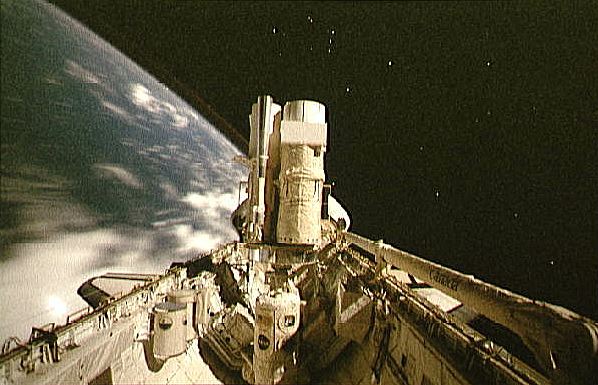
Following the scientific success of the Astro-1 mission, Astro-2 was approved as a follow-up flight. The three ultraviolet telescopes, which flew on Astro-1, were reassembled for Astro-2. These telescopes were (1) the Ultraviolet Imaging Telescope (UIT) operating in the 1200-3100 Angstrom range, (2) the Hopkins Ultraviolet Telescope (HUT) operating from 425 to 1850 Angstroms, and (3) the Wisconsin Ultraviolet Photopolarimetry Experiment (WUPPE) operating from 1250 to 3200 Angtroms. HUT was significantly upgraded for this second flight, with new optical coatings, which enhanced the telescope's performance by more than a factor of two. The three telescopes were planned to make simultaneous observations of objects such as stars, galaxies and quasars, since many science objectives and selected astronomical targets of the three instrument teams are interrelated. BBXRT, which was onboard ASTRO 1, was not flown on ASTRO 2.
The telescopes were mounted on a Spacelab pallet in the payload bay of the shuttle (flight STS-67). The Spacelab Instrument Pointing System (IPS), pallets, and avionics were utilized for attachment to the Shuttle and for control and data handling. The IPS provides a stable platform, keeps the telescopes aligned, and provides various pointing and tracking capabilities to the telescopes. The Astro observatory requires both mission specialists and payload specialists to control its operations from the Shuttle aft flight deck. Instrument monitoring and quick-look data analysis are planned for real-time ground operations.
The Guest Observer Program was included for Astro-2. The telescopes observed over 250 astronomical objects before returning to earth after a 16-day flight.
Alternate Names
- Astro2
- STS-67/Astro-2
Facts in Brief
Launch Date: 1995-03-02
Launch Vehicle: Shuttle
Launch Site: Cape Canaveral, United States
Funding Agency
- NASA-Office of Space Science (United States)
Disciplines
- Planetary Science
- Astronomy
Additional Information
Questions and comments about this spacecraft can be directed to: Coordinated Request and User Support Office
Personnel
| Name | Role | Original Affiliation | |
|---|---|---|---|
| Mr. William Huddleston | Program Manager | NASA Headquarters | |
| Dr. Jack A. Jones | Mission Manager | NASA Marshall Space Flight Center | |
| Dr. Charles A. Meegan | Mission Scientist | NASA Marshall Space Flight Center | charles.meegan@msfc.nasa.gov |
| Dr. Leon B. Allen | Project Manager | NASA Marshall Space Flight Center | |
| Dr. Edward J. Weiler | Program Scientist | NASA Headquarters | edward.j.weiler@nasa.gov |
| Dr. Theodore R. Gull | Mission Scientist | NASA Goddard Space Flight Center | gull@stars.gsfc.nasa.gov |
Related Information/Data at NSSDCA
STS 67 (Astro 2 mission)
Astro 1
US Active Archive for Astro 2 Information/Data
The Astro Archive at MAST (STScI)
Other Sources of Astro 2 Information/Data
Hopkins Ultraviolet Telescope (HUT) team page
Ultraviolet Imaging Telescope (UIT) team page
Wisconsin Ultraviolet Photopolarimeter Experiment (WUPPE) team page
![[USA.gov]](/logo/usagov_logo.gif)
