
- Friday, 04 October 2024

Mars 1969A
NSSDCA ID: MARS69A
Description
This Soviet Mars mission was never officially announced but has since been identified as a planned orbiter. After successful operation of the first two stages, the third stage of the Proton SL-12/D-1-e (8K82K, #240-01 + 11S824) launcher experienced a malfunction in a rotor bearing which caused the turbopump to catch fire. The engine shut down 438.66 seconds after launch and exploded, the remains of the craft landing in the Altai mountains.
Spacecraft and Subsystems
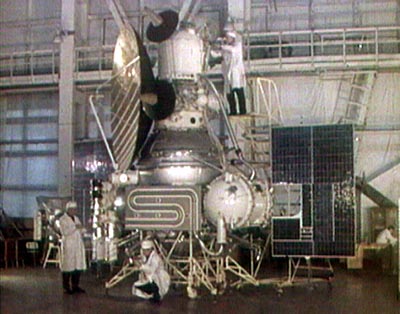
This mission was one of two identical probes launched in the spring of 1969. The payload was an M-69 class probe (#521) with a launch mass of 4850 kg. The probe was built around a spherical propellant compartment with an inner baffle to separate it into two isolated partitions. Two solar panel wings with a total surface area of 7 square meters were mounted on either side of the compartment. A 2.8 m diameter parabolic dish antenna was mounted near the top of the probe, along with three pressurized compartments, the top compartment holding electronics, the second the radio and navigation systems, and the third cameras, a battery, and telemetry devices. Also mounted on the outside of the spacecraft were two conical antennas and a suite of scientific sensors.
The main engine was mounted at the bottom of the probe and used a turbopump to run on the nitrogen tetroxide and unsymmetrical dimethyl hydrazine (UDMH) contained in the main propellant compartment. Eight thrusters with their own fuel tanks and 9 helium pressurization tanks controlled pitch (2 thrusters), yaw (2), and roll (4). Three-axis stabilization and orientation were achieved using 2 Sun sensors, 2 Earth sensors, 2 Mars sensors, a Canopus sensor, gyros, and small thrusters using pressurized nitrogen gas stored in ten tanks. Power at 12 amps was supplied by the solar panels and used to run the spacecraft directly and charge a hermetically sealed cadmium-nickel 110 amp-hour storage battery.
Communications were via two transmitters in the centimeter band (6 GHz) which operated at 25,000 W and transmitted at 6000 bits/s and two transmitters and three receivers in the decimeter band (790-940 MHz) at 100 W and 128 bits/s and a 500 channel telemetry system. The parabolic dish was a directional high-gain antenna for use as the spacecraft neared Mars and the low-gain conical antennas were semi-directional. Thermal control was achieved through passive screen-vacuum insulation and through an active system in the pressurized compartments which consisted of a ventilation and air circulation unit which could run through radiators exposed to sunlight or in shadow.
The spacecraft scientific payload consisted primarily of three television cameras designed to image the surface of Mars. The cameras had three color filters and two lenses, a 50-mm lens with a nominal field of view of 1500 x 1500 km and a 350-mm lens which had a field of 100 x 100 km. An image was 1024 x 1024 pixels for a maximum resolution of 200 to 500 meters. The camera system consisted of film, a processing unit, an exposure unit, and a data encoder to prepare the images for transmission. The camera could store 160 images. The spacecraft also carried a radiometer, water vapor detector, ultraviolet and infrared spectrometers, a radiation detector, gamma spectrometer, hydrogen/helium mass spectrometer, solar plasma spectrometer, and a low-energy ion spectrometer.
Planned Mission Profile
The nominal mission plan was to use the first three stages of the Proton booster and the Block-D upper stage to place the spacecraft into earth parking orbit. The upper stage would then be reignited after one orbit to begin the escape sequence. The spacecraft main engine would then be used for the final boost to put the spacecraft into Mars trajectory. The main engine would also be used for two trajectory correction maneuvers during the 6 month cruise to Mars. The main engine would then be used to put the spacecraft into a 1700 x 34,000 km capture orbit around Mars with an inclination of 40 degrees and a period of 24 hours. Photography and other experiments would take place from this orbit. Then the periapsis would be lowered to 500 to 700 km for a nominal three month session of imaging and data collection from orbit.
Spacecraft image for illustrative purposes - not necessarily in the public domain.
Alternate Names
- M-69 No.521
- Mars 69A
- Mars1969A
Facts in Brief
Launch Date: 1969-03-27
Launch Vehicle: Proton Booster Plus Upper Stage
Launch Site: Tyuratam (Baikonur Cosmodrome), Kazakhstan
Mass: 4850 kg
Funding Agency
- Unknown (U.S.S.R)
Discipline
- Planetary Science
Additional Information
Questions and comments about this spacecraft can be directed to: Dr. David R. Williams
Personnel
| Name | Role | Original Affiliation | |
|---|---|---|---|
| Mr. Artem Ivankov | General Contact | Lavochkin Association | artem.ivankov@laspace.ru |
Selected References
- Lantratov, K., Mars-69: The forgotten mission to the Red Planet, Quest, 7, No. 2, 26-31, 1999.
- Perminov, V. G., The difficult road to Mars - A brief history of Mars exploration in the Soviet Union, NASA, No. 15, Wash, DC, July 1999.
![[USA.gov]](/logo/usagov_logo.gif)
