<?xml version="1.0" encoding="UTF-8"?>
<!DOCTYPE html PUBLIC "-//W3C//DTD XHTML 1.0 Transitional//EN" "http://www.w3.org/TR/xhtml1/DTD/xhtml1-transitional.dtd">
<html xmlns="http://www.w3.org/1999/xhtml"><head><title>NASA - NSSDC - Spacecraft - Details</title><meta http-equiv="Content-Type" content="text/html; charset=utf-8" />
<meta name="description" content="NSSDC Master Catalog" />
<meta name="keywords" content="NASA, NSSDC, NSSDC Master Catalog, NMC, spacecraft, experiments, datasets, data collections, personnel, space events, lunar maps, planetary maps, new data, updated data, lunar events, planetary events, historical events" />
<meta name="orgcode" content="690.1" />
<meta name="rno" content="Edwin.J.Grayzeck.1" />
<meta name="content-owner" content="Edwin.J.Grayzeck.1" />
<meta name="webmaster" content="Edwin.V.Bell.1" />
<link rel="stylesheet" type="text/css" media="screen" href="/style/everyone.css" />

<style type="text/css" media="screen">
@import url("/style/nasa_style.css");
@import url("/style/jin_style.css");
</style>
<!--
<style type="text/css" media="screen">
@import url("/style/style_iefixes.css");
</style>
-->
<link rel="stylesheet" type="text/css" media="print" href="/style/print.css" />
<link rel="stylesheet" type="text/css" media="print" href="/style/jin_print.css" />
<link rel="stylesheet" type="text/css" media="handheld" href="/style/handheld.css" />
</head><body><div id="paper">


  <div id="nasahead">
    <a href="http://www.nasa.gov/" target="_blank"><img src="/logo/nasa_bigheader_logo.gif" alt="NASA Logo, National Aeronautics and Space Administration" width="288" height="51" vspace="6" /></a>

    <div id="links">
      <ul>
        <li>Monday, 20 May 2013</li>
      </ul>
    </div>
  </div>
<div id="contentwrapper"><div id="rightcontent"><div id="headimage"><img height="100" width="530" alt="National Space Science Data Center Header" src="/logo/nssdc_header.jpg"/></div><h1>Mars 96 Penetrator</h1><p><strong>NSSDC ID:</strong> MARS96E<br/></p><div class="twocol"><div class="urone"><h2>Description</h2><p>
          The Mars 96 spacecraft was launched into Earth orbit, but failed to achieve insertion into Mars cruise trajectory and re-entered the Earth's atmosphere at about 00:45 to 01:30 UT on 17 November 1996 and crashed within a presumed 320 km by 80 km area which includes parts of the Pacific Ocean, Chile, and Bolivia. The cause of the crash is not known.
</p>
<p>
The Russian Mars 96 mission was designed to send an orbiter, two small autonomous stations, and two surface penetrators to Mars to investigate the evolution and contemporary physics of the planet by studying the physical and chemical processes which took place in the past and which currently take place. Mars 96 was scheduled to arrive at Mars on 12 September 1997, about 10 months after launch, on a direct trajectory.
</p>
<p>
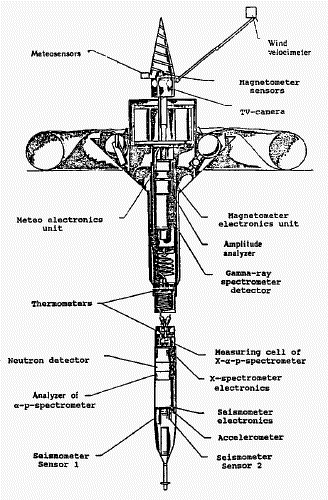
The two Mars 96 Penetrators were mounted on the bottom of the orbiter near the propulsion system. The penetrators were long thin cylinders, pointed at the bottom, or forebody, and with a widened, funnel-shaped top. Instruments were contained inside throughout the length of the cylinder. The scientific objectives of the penetrator experiments were to obtain images of the surface, study martian meteorology, examine the physical, chemical, magnetic, and mechanical properties of the martian regolith, including its water content, collect data on the magnetic field, and record seismic activity.
</p>
<p>
After orbit insertion, adjustment to 300 km periapsis, and 7 to 28 days of orbital maneuvers, the orbiter would be properly oriented and the first penetrator would be spun about its long axis and released. When the penetrator had moved away from the orbiter, its solid rocket motor was to ignite and put it into an atmospheric entry trajectory. Entry would occur 21 to 22 hours later. The penetrator was to enter the atmosphere at about 4.9 km/sec at an angle 10-14 degrees. The probe would first be slowed aerodynamically, followed by inflation of a braking device. The penetrator was to strike the surface at approximately 80 m/s. The forebody would separate on impact and can penetrate 5 to 6 meters into the ground, attached by wires to the aftbody, the top of the aftbody remaining above the surface. The plan called for the first penetrator to land near the site of one of the surface stations, and the second to land at least 90 degrees away. Both penetrators could have been released on the same orbit.
</p>
<p>
The penetrator was equipped with instruments in both the forebody and aftbody. The forebody held a seismometer, accelerometer, thermoprobe, neutron detector, and an alpha-proton-X-ray spectrometer. The aftbody contained a gamma-ray spectrometer and thermoprobe within the part of the cylinder underground, and meteorology sensors, a magnetometer, a television camera, and transmitter exposed at the top. The experiments were to begin after landing. Data was to be transmitted to the orbiter and then relayed to Earth. The penetrators have an expected lifetime of 1 year.
          </p></div><div class="urtwo"><h2>Facts in Brief</h2><p><strong>Launch Date:</strong> 1996-11-16<br/><strong>Launch Vehicle:</strong> Proton<br/><strong>Launch Site:</strong> Tyuratam (Baikonur Cosmodrome), Kazakhstan<br/><strong>Mass:</strong> 45.0 kg<br/></p><h2>Funding Agency</h2><ul><li>Russian Space Agency (Russia)</li></ul><h2>Discipline</h2><ul><li>Planetary Science</li></ul><h2>Additional Information</h2><ul><li><a href="spacecraftOrbit.do?id=MARS96E">Launch/Orbital information for Mars 96 Penetrator</a></li><li><a href="spacecraftPdmp.do?id=MARS96E">PDMP information for Mars 96 Penetrator</a></li><li><a href="spacecraftTelemetry.do?id=MARS96E">Telecommunications information for Mars 96 Penetrator</a></li></ul><ul><li><a href="experimentSearch.do?spacecraft=Mars 96 Penetrator">Experiments on Mars 96 Penetrator</a></li><li><a href="datasetSearch.do?spacecraft=Mars 96 Penetrator">Data collections from Mars 96 Penetrator</a></li></ul><h2/><p>
          Questions or comments about this spacecraft can be directed to:
          <a href="mailto:David.R.Williams@nasa.gov?Subject=NMC Comment/Question: Mars 96 Penetrator (MARS96E)">Dr. David R. Williams</a>.
          </p></div></div><div class="clear"> </div><h2>Personnel</h2><table cellspacing="0" class="datatab"><thead><tr><th>Name</th><th>Role</th><th>Original Affiliation</th><th>E-mail</th></tr></thead><tbody><tr><td>Dr. Albert A. Galeev</td><td>Program Scientist</td><td>Russian Academy of Sciences</td><td>agaleev@iki.rssi.ru</td></tr><tr class="odd"><td>Dr. Alexander V. Zakharov</td><td>Project Scientist</td><td>Russian Academy of Sciences</td><td>zakharov@iki.rssi.ru</td></tr></tbody></table><h2>Other Mars 96 Information from NSSDC</h2>

<p>
<a href="/planetary/text/mars96_timeline.txt">Mars 96 Failure</a> - Timeline from launch to re-entry<br/>
<a href="/nmc/spacecraftDisplay.do?id=1996-064A">Mars 96 Orbiter</a><br/>
<a href="/nmc/spacecraftDisplay.do?id=MARS96B">Mars 96 Surface Station</a>
</p>

<h2>Other Sources of Mars 96 Information</h2>

<p>
<a href="http://www.iki.rssi.ru/mars96/mars96hp.html">Mars 96 Project</a> (IKI)
</p>

<h2>Information about Mars</h2>

<p>
<a href="/planetary/planets/marspage.html">Mars Page</a>
</p>
</div><div id="leftcontent"><div id="leftnav"><h2>NSSDC Master Catalog Search</h2>
  <ul>
    <li id="lnone"><a href="/nmc/SpacecraftQuery.jsp">Spacecraft</a></li>
    <li id="lntwo"><a href="/nmc/ExperimentQuery.jsp">Experiments</a></li>
    <li id="lnthree"><a href="/nmc/DatasetQuery.jsp">Data Collections</a></li>
    <li id="lnfour"><a href="/nmc/PersonQuery.jsp">Personnel</a></li>
    <li id="lnfive"><a href="/nmc/PublicationQuery.jsp">Publications</a></li>
    <li id="lnsix"><a href="/nmc/MapQuery.jsp">Maps</a></li>
    <li id="lnseven"><a href="/nmc/NewDataQuery.jsp">New/Updated Data</a></li>
    <li id="lneight"><a href="/nmc/EventQuery.jsp">Lunar/Planetary Events</a></li>
  </ul>
</div><div style="width:175px;" class="capleft"><a href="http://nssdc.gsfc.nasa.gov/image/spacecraft/mars96_penetrator.gif"><img height="267" width="175" alt="Image of the Mars 96 Penetrator spacecraft" src="http://nssdc.gsfc.nasa.gov/thumbnail/spacecraft/mars96_penetrator.gif"/></a><p>Mars 96 Penetrator</p></div></div></div>  <div id="nasafoot">
    <a href="http://www.usa.gov/" target="_blank"><img src="/logo/usagov_logo.gif" width="130" height="34" alt="[USA.gov]" /></a>

    <div id="nasafootplus">
      <ul>
        <li>+ <a href="http://www.nasa.gov/about/highlights/HP_Privacy.html">Privacy Policy and Important Notices</a></li>
      </ul>
    </div>

    <a href="http://www.nasa.gov/" target="_blank"><img id="nasafootr" src="/logo/nasa_logo_small.gif" width="61" height="40" vspace="5" alt="NASA Logo - nasa.gov" /></a>

    <div id="nasafootlinks">
      <ul>
        <li>NASA Official: <a href="mailto:Edwin.J.Grayzeck@nasa.gov">Dr. Ed Grayzeck</a></li>
        <li>Curator: <a href="mailto:Ed.Bell@nasa.gov">E. Bell, II</a></li>
        <li>Version 4.0.21, 27 March 2013</li>
      </ul>
    </div>
  </div>
</div></body></html>