
- Monday, 15 July 2024

Ranger 8
NSSDCA/COSPAR ID: 1965-010A
Description
Ranger 8 was designed to achieve a lunar impact trajectory and to transmit high-resolution photographs of the lunar surface during the final minutes of flight up to impact. The spacecraft carried six television vidicon cameras, 2 full-scan cameras (channel F, one wide-angle, one narrow-angle) and 4 partial scan cameras (channel P, two wide-angle, two narrow-angle) to accomplish these objectives. The cameras were arranged in two separate chains, or channels, each self-contained with separate power supplies, timers, and transmitters so as to afford the greatest reliability and probability of obtaining high-quality video pictures. No other experiments were carried on the spacecraft.
Spacecraft and Subsystems
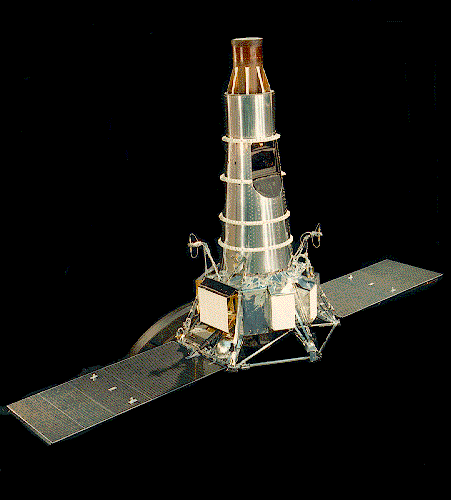
Rangers 6, 7, 8, and 9 were the so-called Block 3 versions of the Ranger spacecraft. The spacecraft consisted of a hexagonal aluminum frame base 1.5 m across on which was mounted the propulsion and power units, topped by a truncated conical tower which held the TV cameras. Two solar panel wings, each 73.9 cm wide by 153.7 cm long, extended from opposite edges of the base with a full span of 4.6 m, and a pointable high gain dish antenna was hinge mounted at one of the corners of the base away from the solar panels. A cylindrical quasiomnidirectional antenna was seated on top of the conical tower. The overall height of the spacecraft was 3.6 m.
Propulsion for the mid-course trajectory correction was provided by a 224-N thrust monopropellant hydrazine engine with 4 jet-vane vector control. Orientation and attitude control about 3 axes was enabled by 12 nitrogen gas jets coupled to a system of 3 gyros, 4 primary Sun sensors, 2 secondary Sun sensors, and an Earth sensor. Power was supplied by 9792 Si solar cells contained in the two solar panels, giving a total array area of 2.3 square meters and producing 200 W. Two 1200 Watt-hr AgZnO batteries rated at 26.5 V with a capacity for 9 hours of operation provided power to each of the separate communication/TV camera chains. Two 1000 Watt-hr AgZnO batteries stored power for spacecraft operations.
Communications were through the quasiomnidirectional low-gain antenna and the parabolic high-gain antenna. Transmitters aboard the spacecraft included a 60 W TV channel F at 959.52 MHz, a 60 W TV channel P at 960.05 MHz, and a 3 W transponder channel 8 at 960.58 MHz. The telecommunications equipment converted the composite video signal from the camera transmitters into an RF signal for subsequent transmission through the spacecraft high-gain antenna. Sufficient video bandwidth was provided to allow for rapid framing sequences of both narrow- and wide-angle television pictures.
Mission Profile
The Atlas 196D and Agena B 6006 boosters performed nominally, injecting the Agena and Ranger 8 into an Earth parking orbit at 185 km altitude 7 minutes after launch. Fourteen minutes later a 90 second burn of the Agena put the spacecraft into lunar transfer trajectory, and several minutes later the Ranger and Agena separated. The Ranger solar panels were deployed, attitude control activated, and spacecraft transmissions switched from the omniantenna to the high-gain antenna by 21:30 UT. On 18 February at a distance of 160,000 km from Earth the planned mid-course maneuver took place, involving reorientation and a 59 second rocket burn. During the 27 minute maneuver, spacecraft transmitter power dropped severely, so that lock was lost on all telemetry channels. This continued intermittently until the rocket burn, at which time power returned to normal. The telemetry dropout had no serious effects on the mission. A planned terminal sequence to point the cameras more in the direction of flight just before reaching the Moon was cancelled to allow the cameras to cover a greater area of the Moon's surface.
Ranger 8 reached the Moon on 20 February 1965. The first image was taken at 9:34:32 UT at an altitude of 2510 km. Transmission of 7,137 photographs of good quality occurred over the final 23 minutes of flight. The final image taken before impact has a resolution of 1.5 meters. The spacecraft encountered the lunar surface in a direct hyperbolic trajectory, with incoming asymptotic direction at an angle of -13.6 degrees from the lunar equator. The orbit plane was inclined 16.5 degrees to the lunar equator. After 64.9 hours of flight, impact occurred at 09:57:36.756 UT on 20 February 1965 in Mare Tranquillitatis at 2.6376 degrees N, 24.7881 degrees E. (As determined from Lunar Reconnaissance Orbiter images) Impact velocity was slightly less than 2.68 km/s. The spacecraft performance was excellent.
Total research, development, launch, and support costs for the Ranger series of spacecraft (Rangers 1 through 9) was approximately $170 million.
Alternate Names
- 01086
- Ranger8
Facts in Brief
Launch Date: 1965-02-17
Launch Vehicle: Atlas-Agena B
Launch Site: Cape Canaveral, United States
Mass: 367 kg
Nominal Power: 200 W
Funding Agency
- NASA-Office of Space Science Applications (United States)
Discipline
- Planetary Science
Additional Information
Questions and comments about this spacecraft can be directed to: Dr. David R. Williams
Personnel
| Name | Role | Original Affiliation |
|---|
Selected References
- Ranger 8 and 9, JPL, Calif. Inst. Technol., TR 32-800, Pt. 1 and 2, Pasadena, CA, Jan. 1966.
- Ranger 8 and 9, TRW Space Log, TRW Systems, 5, No. 2, 47-48, Redondo Beach, Calif., 1965.
- Ranger 8 photographs of the moon - Cameras 'A', 'B', and 'P', NASA, SP-111, Wash., D.C., 1966.
Other Ranger Information/Data at NSSDCA
Ranger 1
Ranger 2
Ranger 3
Ranger 4
Ranger 5
Ranger 6
Ranger 7
Ranger 9
Ranger Home Page
Related Information/Data at NSSDCA
Lunar Exploration Home Page
Moon Home Page
Moon Fact Sheet
Other Sources of Ranger Information/Data
Lunar Impact: A History of Project Ranger
Ranger 8 information at the Lunar and Planetary Institute
![[USA.gov]](/logo/usagov_logo.gif)
