<?xml version="1.0" encoding="UTF-8"?>
<!DOCTYPE html PUBLIC "-//W3C//DTD XHTML 1.0 Transitional//EN" "http://www.w3.org/TR/xhtml1/DTD/xhtml1-transitional.dtd">
<html xmlns="http://www.w3.org/1999/xhtml"><head><title>NASA - NSSDC - Spacecraft - Details</title><meta http-equiv="Content-Type" content="text/html; charset=utf-8" />
<meta name="description" content="NSSDC Master Catalog" />
<meta name="keywords" content="NASA, NSSDC, NSSDC Master Catalog, NMC, spacecraft, experiments, datasets, data collections, personnel, space events, lunar maps, planetary maps, new data, updated data, lunar events, planetary events, historical events" />
<meta name="orgcode" content="690.1" />
<meta name="rno" content="Edwin.J.Grayzeck.1" />
<meta name="content-owner" content="Edwin.J.Grayzeck.1" />
<meta name="webmaster" content="Edwin.V.Bell.1" />
<link rel="stylesheet" type="text/css" media="screen" href="/style/everyone.css" />

<style type="text/css" media="screen">
@import url("/style/nasa_style.css");
@import url("/style/jin_style.css");
</style>
<!--
<style type="text/css" media="screen">
@import url("/style/style_iefixes.css");
</style>
-->
<link rel="stylesheet" type="text/css" media="print" href="/style/print.css" />
<link rel="stylesheet" type="text/css" media="print" href="/style/jin_print.css" />
<link rel="stylesheet" type="text/css" media="handheld" href="/style/handheld.css" />
</head><body><div id="paper">


  <div id="nasahead">
    <a href="http://www.nasa.gov/" target="_blank"><img src="/logo/nasa_bigheader_logo.gif" alt="NASA Logo, National Aeronautics and Space Administration" width="288" height="51" vspace="6" /></a>

    <div id="links">
      <ul>
        <li>Thursday, 20 June 2013</li>
      </ul>
    </div>
  </div>
<div id="contentwrapper"><div id="rightcontent"><div id="headimage"><img height="100" width="530" alt="National Space Science Data Center Header" src="/logo/nssdc_header.jpg"/></div><h1>Ranger 1</h1><p><strong>NSSDC/COSPAR ID:</strong> 1961-021A</p><div class="twocol"><div class="urone"><h2>Description</h2><p>
          Ranger 1 was a spacecraft whose primary mission was to test the performance of those functions and parts necessary for carrying out subsequent lunar and planetary missions using essentially the same spacecraft design. A secondary objective was to study the nature of particles and fields in interplanetary space.
</p>
<h4>Spacecraft and Subsystems</h4>
<p>
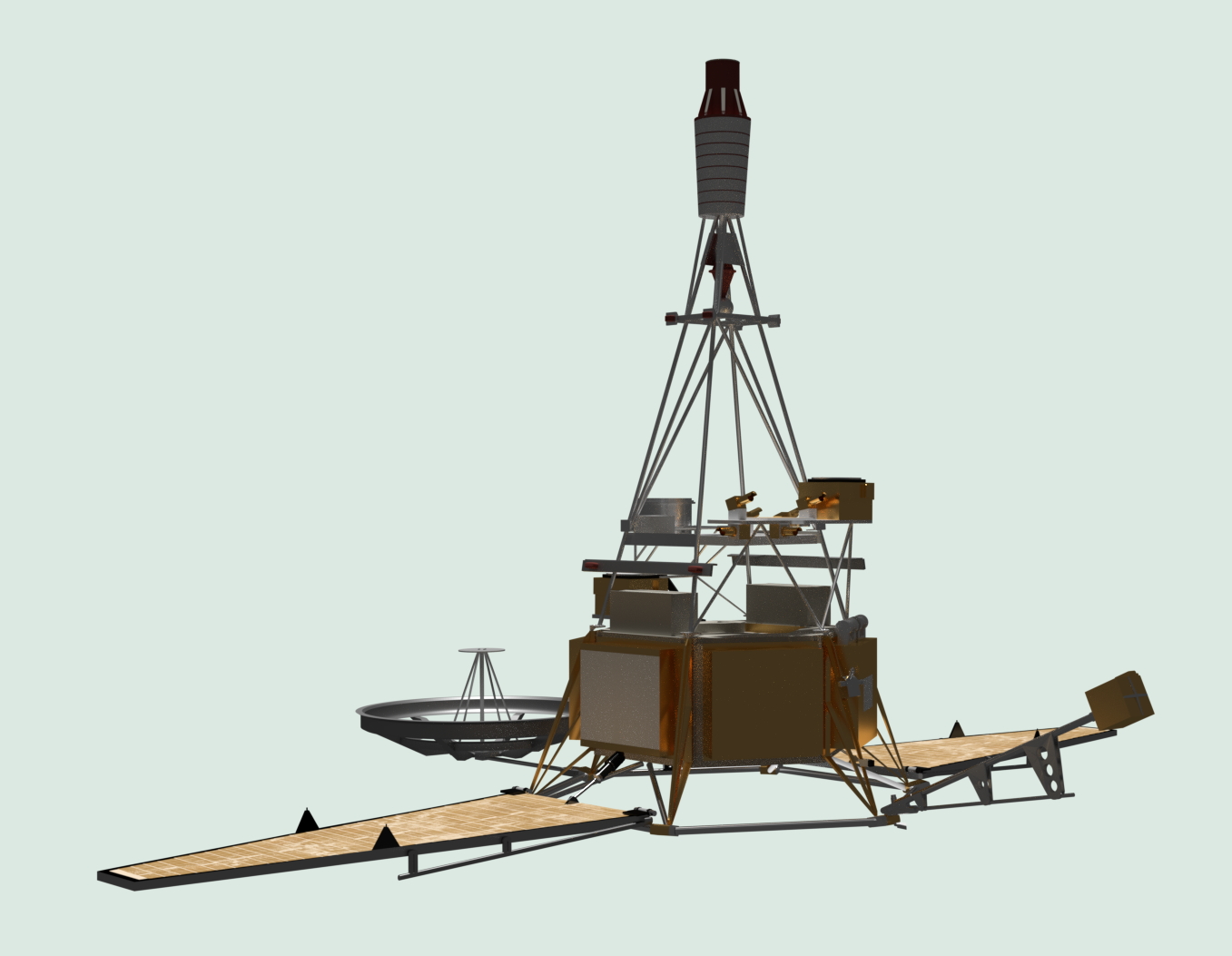
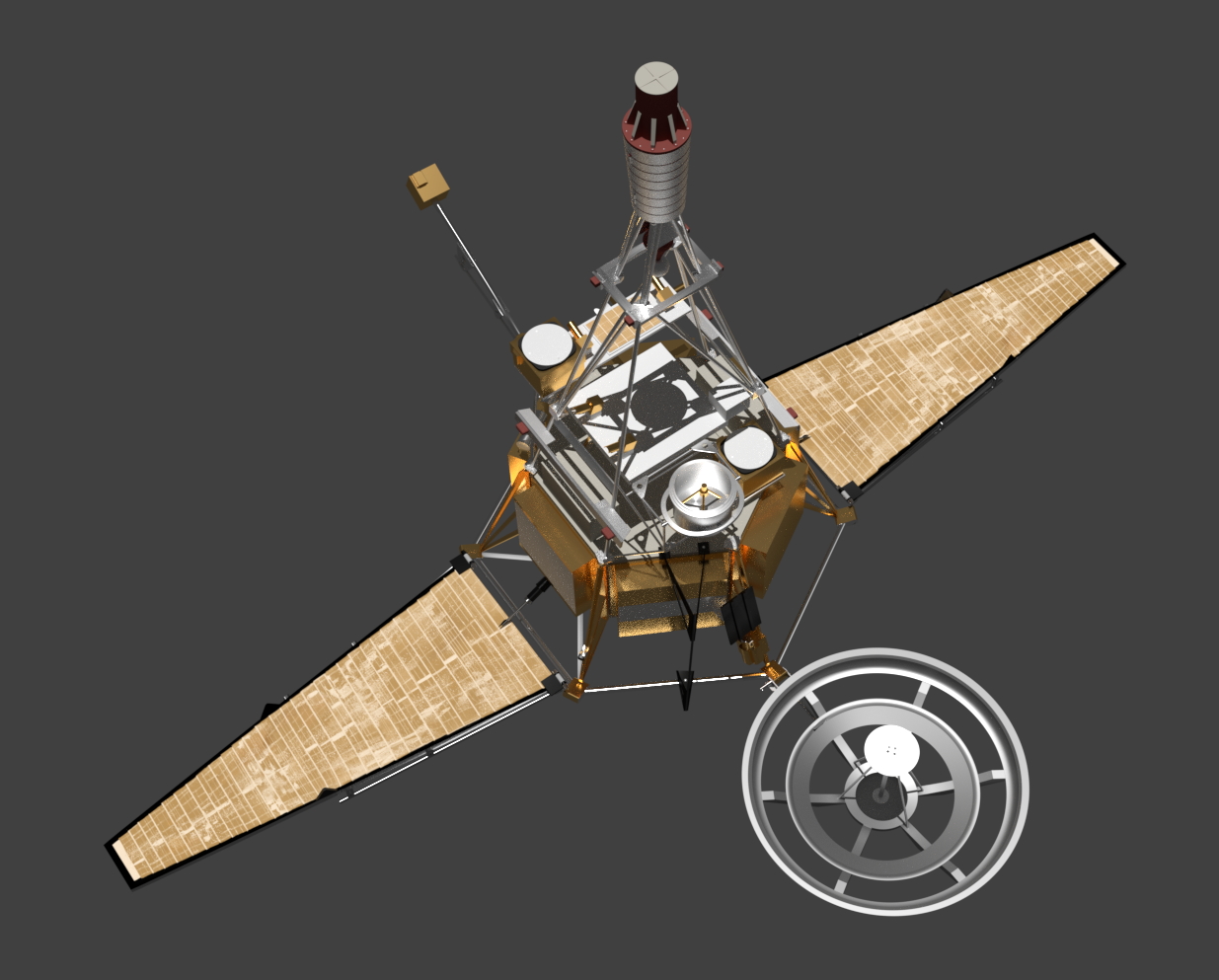
The spacecraft was of the Ranger Block 1 design and consisted of a hexagonal base 1.5 m across upon which was mounted a cone-shaped 4 m high tower of aluminum struts and braces. Two solar panel wings measuring 5.2 m from tip to tip extended from the base. A high-gain directional dish antenna was attached to the bottom of the base. Spacecraft experiments and other equipment were mounted on the base and tower. Instruments aboard the spacecraft included a Lyman-alpha telescope, a rubidium-vapor magnetometer, electrostatic analyzers,medium-energy range particle detectors, two triple coincidence telescopes,a cosmic-ray integrating ionization chamber, cosmic dust detectors, and solar X-ray scintillation counters.
</p>
<p>
The communications system included the high gain antenna and an omni-directional medium gain antenna and two transmitters, one at 960.1-mhz with 0.25 W power output and the other at 960.05-mhz with 3 W power output. Power was to be furnished by 8680 solar cells on the two panels, a 57 kg silver-zinc battery, and smaller batteries on some of the experiments. Attitude control was provided by a solid-state timing controller, Sun and Earth sensors, and pitch and roll jets. The temperature was controlled passively by gold plating, white paint, and polished aluminum surfaces.
</p>
<h4>Mission Profile</h4>
<p>
The Ranger 1 spacecraft was designed to go into an Earth parking orbit and then into a 60,000 x 1,100,000 km Earth orbit to test systems and strategies for future lunar missions. Ranger 1 was launched into the Earth parking orbit as planned, but the Agena B failed to restart to put it into the higher trajectory, so when Ranger 1 separated from the Agena stage it went into a low Earth orbit and began tumbling. The satellite re-entered Earth's atmosphere on 30 August 1961. Ranger 1 was partially successful, much of the primary objective of flight testing the equipment was accomplished but little scientific data was returned.
</p>
<p>
Total research, development, launch, and support costs for the Ranger series of spacecraft (Rangers 1 through 9) was approximately $170 million.
          </p></div><div class="urtwo"><h2>Alternate Names</h2><ul><li>00173</li></ul><h2>Facts in Brief</h2><p><strong>Launch Date:</strong> 1961-08-23<br/><strong>Launch Vehicle:</strong> Atlas-Agena B<br/><strong>Launch Site:</strong> Cape Canaveral, United States<br/><strong>Mass:</strong> 306.2 kg<br/></p><h2>Funding Agency</h2><ul><li>NASA-Office of Space Science Applications (United States)</li></ul><h2>Disciplines</h2><ul><li>Planetary Science</li><li>Space Physics</li></ul><h2>Additional Information</h2><ul><li><a href="spacecraftOrbit.do?id=1961-021A">Launch/Orbital information for Ranger 1</a></li></ul><ul><li><a href="experimentSearch.do?spacecraft=Ranger 1">Experiments on Ranger 1</a></li><li><a href="datasetSearch.do?spacecraft=Ranger 1">Data collections from Ranger 1</a></li></ul><h2/><p>
          Questions or comments about this spacecraft can be directed to:
          <a href="mailto:David.R.Williams@nasa.gov?Subject=NMC Comment/Question: Ranger 1 (1961-021A)">Dr. David R. Williams</a>.
          </p></div></div><div class="clear"> </div><h2>Selected References</h2><p>
      Scientific experiments for Ranger 1 and 2,
      JPL, Calif. Inst. Technol., TR 32-55, Pasadena, CA, Jan. 1961.
      </p><p>
      Ranger I misses planned path; Systems working in low orbit,
      <em>Space Technol.</em>, 4, No. 4, 15, Oct. 1961.
      </p><h2>Other Ranger Information/Data at NSSDC</h2>

<p>
   <a href="http://nssdc.gsfc.nasa.gov/nmc/spacecraftDisplay.do?id=1961-021A">Ranger 1</a><br/>
   <a href="http://nssdc.gsfc.nasa.gov/nmc/spacecraftDisplay.do?id=1961-032A">Ranger 2</a><br/>
   <a href="http://nssdc.gsfc.nasa.gov/nmc/spacecraftDisplay.do?id=1962-001A">Ranger 3</a><br/>
   <a href="http://nssdc.gsfc.nasa.gov/nmc/spacecraftDisplay.do?id=1962-012A">Ranger 4</a><br/>
   <a href="http://nssdc.gsfc.nasa.gov/nmc/spacecraftDisplay.do?id=1962-055A">Ranger 5</a><br/>
   <a href="http://nssdc.gsfc.nasa.gov/nmc/spacecraftDisplay.do?id=1964-007A">Ranger 6</a><br/>
   <a href="http://nssdc.gsfc.nasa.gov/nmc/spacecraftDisplay.do?id=1964-041A">Ranger 7</a><br/>
   <a href="http://nssdc.gsfc.nasa.gov/nmc/spacecraftDisplay.do?id=1965-010A">Ranger 8</a><br/>
   <a href="http://nssdc.gsfc.nasa.gov/nmc/spacecraftDisplay.do?id=1965-023A">Ranger 9</a><br/>
   <a href="/planetary/lunar/ranger.html">Ranger Home Page</a>
</p>

<h2>Related Information/Data at NSSDC</h2>

<p>
   <a href="/planetary/lunar/apollo_25th.html">Lunar Exploration Home Page</a><br/>
   <a href="/planetary/planets/moonpage.html">Moon Home Page</a><br/>
   <a href="/planetary/factsheet/moonfact.html">Moon Fact Sheet</a>
</p>

<h2>Other Sources of Ranger Information/Data</h2>

<p>
<a href="http://history.nasa.gov/SP-4210/pages/Cover.htm">Lunar Impact: A History of Project Ranger</a>
</p></div><div id="leftcontent"><div id="leftnav"><h2>NSSDC Master Catalog Search</h2>
  <ul>
    <li id="lnone"><a href="/nmc/SpacecraftQuery.jsp">Spacecraft</a></li>
    <li id="lntwo"><a href="/nmc/ExperimentQuery.jsp">Experiments</a></li>
    <li id="lnthree"><a href="/nmc/DatasetQuery.jsp">Data Collections</a></li>
    <li id="lnfour"><a href="/nmc/PersonQuery.jsp">Personnel</a></li>
    <li id="lnfive"><a href="/nmc/PublicationQuery.jsp">Publications</a></li>
    <li id="lnsix"><a href="/nmc/MapQuery.jsp">Maps</a></li>
    <li id="lnseven"><a href="/nmc/NewDataQuery.jsp">New/Updated Data</a></li>
    <li id="lneight"><a href="/nmc/EventQuery.jsp">Lunar/Planetary Events</a></li>
  </ul>
</div><div style="width:175px;" class="capleft"><a href="http://nssdc.gsfc.nasa.gov/image/spacecraft/ranger_block1.jpg"><img height="216" width="175" alt="Image of the Ranger 1 spacecraft" src="http://nssdc.gsfc.nasa.gov/thumbnail/spacecraft/ranger_block1.gif"/></a><p>Ranger 1</p></div></div></div>  <div id="nasafoot">
    <a href="http://www.usa.gov/" target="_blank"><img src="/logo/usagov_logo.gif" width="130" height="34" alt="[USA.gov]" /></a>

    <div id="nasafootplus">
      <ul>
        <li>+ <a href="http://www.nasa.gov/about/highlights/HP_Privacy.html">Privacy Policy and Important Notices</a></li>
      </ul>
    </div>

    <a href="http://www.nasa.gov/" target="_blank"><img id="nasafootr" src="/logo/nasa_logo_small.gif" width="61" height="40" vspace="5" alt="NASA Logo - nasa.gov" /></a>

    <div id="nasafootlinks">
      <ul>
        <li>NASA Official: <a href="mailto:Edwin.J.Grayzeck@nasa.gov">Dr. Ed Grayzeck</a></li>
        <li>Curator: <a href="mailto:Ed.Bell@nasa.gov">E. Bell, II</a></li>
        <li>Version 4.0.24, 14 June 2013</li>
      </ul>
    </div>
  </div>
</div></body></html>