
- Saturday, 03 August 2024

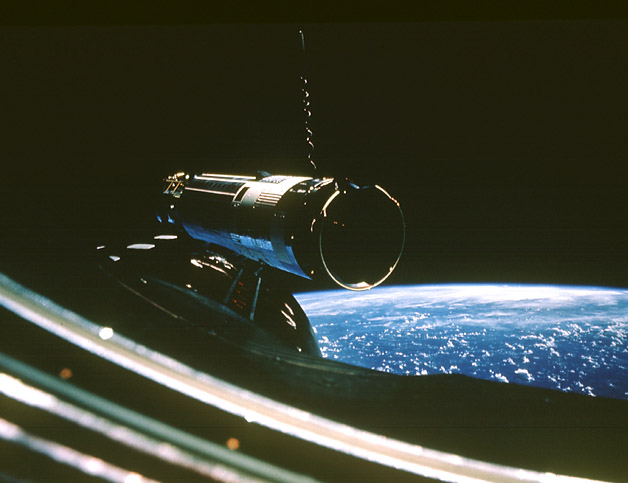
Gemini 10 Target
NSSDCA/COSPAR ID: 1966-065A
Description
The Gemini 10 Agena Target Vehicle (GATV 5005) was successfully launched from Cape Kennedy on July 18, 1966 at 3:39:46 p.m. EST (20:39:46.131 UT) into a near-circular 300 km orbit. Gemini 10, which was launched an hour and 40 minutes later, achieved rendezvous with the GATV at 10:43 p.m. and docked at 11:13:03 p.m. A large out-of-plane error in the initial Gemini 10 orbit required use of 60% of its fuel for the rendezvous, over twice the planned amount. To conserve fuel, Gemini 10 remained docked to GATV-10 for the next 39 hours and used the GATV propulsion system for maneuvers. A 14-second burn of the GATV primary propulsion system was used to raise the dual spacecraft apogee to 764 km. While the spacecraft were docked, a bending mode test was conducted to study spacecraft dynamics. Another burn of the GATV at 3:58 p.m. on 19 July brought the spacecraft into a near-circular 380 km orbit, the same orbit as the GATV which had been launched on 16 March for the Gemini 8 mission. Gemini 10 separated from the GATV at 2:00 p.m. EST on 20 July. After reentry of Gemini 10, a primary propulsion system firing put the GATV into a 386.6 x 1390.8 km orbit to determine temperature effects of such a high orbit on the vehicle (no appreciable differences were found). Another primary system firing followed by a secondary system firing resulted in a circular 352 km orbit. In total, the GATV received and executed 1700 commands, 1350 from ground control and 350 from Gemini 10.
Gemini Agena Target Vehicle
The Gemini Agena Target Vehicle was designed to be launched into Earth orbit prior to a Gemini mission and used for rendezvous and docking practice. The GATV had a docking cone at the forward end into which the nose of the Gemini spacecraft could be inserted and held with docking latches. The GATV was a 7.93 meter long cylinder with a diameter of 1.52 meters, a dry mass of 1835 kg, and a fueled mass at orbital injection of 3282 kg. The forward section of the Agena airframe held the guidance, flight control electronics, telemetry, command, tracking, electrical power, and propellant pressurization equipment. The primary and secondary propulsion systems were at the aft end of the target vehicle with the attitude control gas tanks, and the main propellant (fuel and oxidizer) tanks were located in the mid-section. Propulsion was via a bi-propellant system, using unsymmetrical dimethylhydrazine (UDMH) and inhibited red fuming nitric acid (IRFNA). The Agena propulsion systems could be run while the Gemini was docked, allowing the GATV to be used to change the orbit of the docked pair. A minimum of five engine starts was possible. The docking cone was connected to the front end by shock absorbing dampers. Acquisition running lights and target vehicle status display indicators were situated on the front end. A 2.1 meter long retractable L-band boom antenna extended from the side of the cylinder near the front. Tracking and command of the GATV were also aided by a rendezvous beacon, two spiral L-band antennas, two tracking antennas (C-band and S-band), two VHF telemetry antennas, and a UHF command antenna. Micrometeoroid packages and other experiments could also be mounted on the GATV.
Gemini Program
The Gemini program was designed as a bridge between the Mercury and Apollo programs, primarily to test equipment and mission procedures in Earth orbit and to train astronauts and ground crews for future Apollo missions. The general objectives of the program included: long duration flights in excess of of the requirements of a lunar landing mission; rendezvous and docking of two vehicles in Earth orbit; the development of operational proficiency of both flight and ground crews; the conduct of experiments in space; extravehicular operations; active control of reentry flight path to achieve a precise landing point; and onboard orbital navigation. Each Gemini mission carried two astronauts into Earth orbit for periods ranging from 5 hours to 14 days. The program consisted of 10 crewed launches, 2 uncrewed launches, and 7 target vehicles, at a total cost of approximately 1,280 million dollars.
Alternate Names
- 02348
- Agena Target Vehicle 10
- GATV-5005
- Gemini10Target
Facts in Brief
Launch Date: 1966-07-18
Launch Vehicle: Atlas-Agena D
Launch Site: Cape Canaveral, United States
Mass: 1835 kg
Funding Agency
- NASA-Office of Manned Space Flight (United States)
Discipline
- Engineering
Additional Information
Questions and comments about this spacecraft can be directed to: Dr. David R. Williams
Personnel
| Name | Role | Original Affiliation | |
|---|---|---|---|
| Dr. Charles W. Mathews | Project Manager | NASA Headquarters | |
| Dr. William C. Schneider | Project Manager | NASA Headquarters | |
| Dr. George E. Mueller | Program Manager | NASA Headquarters | info@kistleraero.com |
Selected References
- Gemini summary conference, NASA, SP-138, Wash, DC, Feb. 1967.
- Grimwood, J. M., et al., Project Gemini technology and operations - A chronology, NASA, NASA SP-4002, Wash., DC, 1969.

Gemini and Gemini Agena Target Vehicle.
![[USA.gov]](/logo/usagov_logo.gif)
