
- Wednesday, 05 March 2025

MESSENGER
NSSDCA/COSPAR ID: 2004-030A
Description
The Mercury Surface, Space Environment, Geochemistry and Ranging (MESSENGER) mission is designed to study the characteristics and environment of Mercury from orbit. Specifically, the scientific objectives of the mission are to characterize the chemical composition of Mercury's surface, the geologic history, the nature of the magnetic field, the size and state of the core, the volatile inventory at the poles, and the nature of Mercury's exosphere and magnetosphere over a nominal orbital mission of one Earth year.
Mission Profile
MESSENGER launched on 3 August 2004 at 6:15:56 UT (2:15:56 a.m. EDT) on a Delta 7925H (a Delta II Heavy launch vehicle with nine strap-on solid-rocket boosters). The spacecraft was injected into solar orbit 57 minutes later. The solar panels were then deployed and the spacecraft began sending data on its status.
One year after launch, on 2 August 2005, MESSENGER flew by Earth at an altitude of 2347 km. On 12 December 2005 at 11:30 UT, MESSENGER fired its large thruster for 524 seconds, changing the spacecraft velocity by 316 m/s and putting it on course for its 24 October 2006 Venus flyby at an altitude of 2990 km. The second Venus flyby took place on 5 June 2007 at 23:08 UT (7:08 p.m. EDT) at an altitude of approximately 337 km. The first of three Mercury flybys, all at roughly 200 km altitude, occurred on 14 January 2008 at 19:04 :39 UT, and the second on 6 October 2008 at 08:40:22 UT. The third took place on 29 September 2009 at 21:54:58 UT at a distance of 228 km. There were also five deep space manuevers. Data collected during the Mercury flybys was used to help plan the scientific campaign during the orbital phase.
Mercury orbit insertion took place with a 15 minute burn starting at 00:45 UT on 18 March 2011 (8:45 p.m. 17 March EDT) requiring a delta-V of 0.862 km/s. Science observations began on April 4 at 20:40 UT (4:40 p.m. EDT). The nominal orbit had a periapsis of 200 km at 60 degrees N latitude, an apoapsis of 15,193 km, a period of 12 hours and an inclination of 80 degrees. The periapsis slowly rose due to solar perturbations to over 400 km at the end of 88 days (one Mercury year) at which point it was readjusted to a 200 km, 12 hour orbit via a two burn sequence.
Data was collected from orbit for one Earth year, the end of the primary mission was in March 2012. Extensions to the mission allowed the spacecraft to operate for an additional 3 years until the propellant necessary to maintain its orbit was exhausted. The MESSENGER spacecraft impacted the surface of Mercury as planned on 30 April 2015 at 19:26 UT (3:26 p.m. EDT).
Global stereo image coverage at 250 m/pixel resolution was completed. The mission has also yielded global composition maps, a 3-D model of Mercury's magnetosphere, topographic profiles of the northern hemisphere, gravity field, altitude profiles of elemental species, and a characterization of the volatiles in permanently shadowed craters at the poles.
Spacecraft and Subsystems
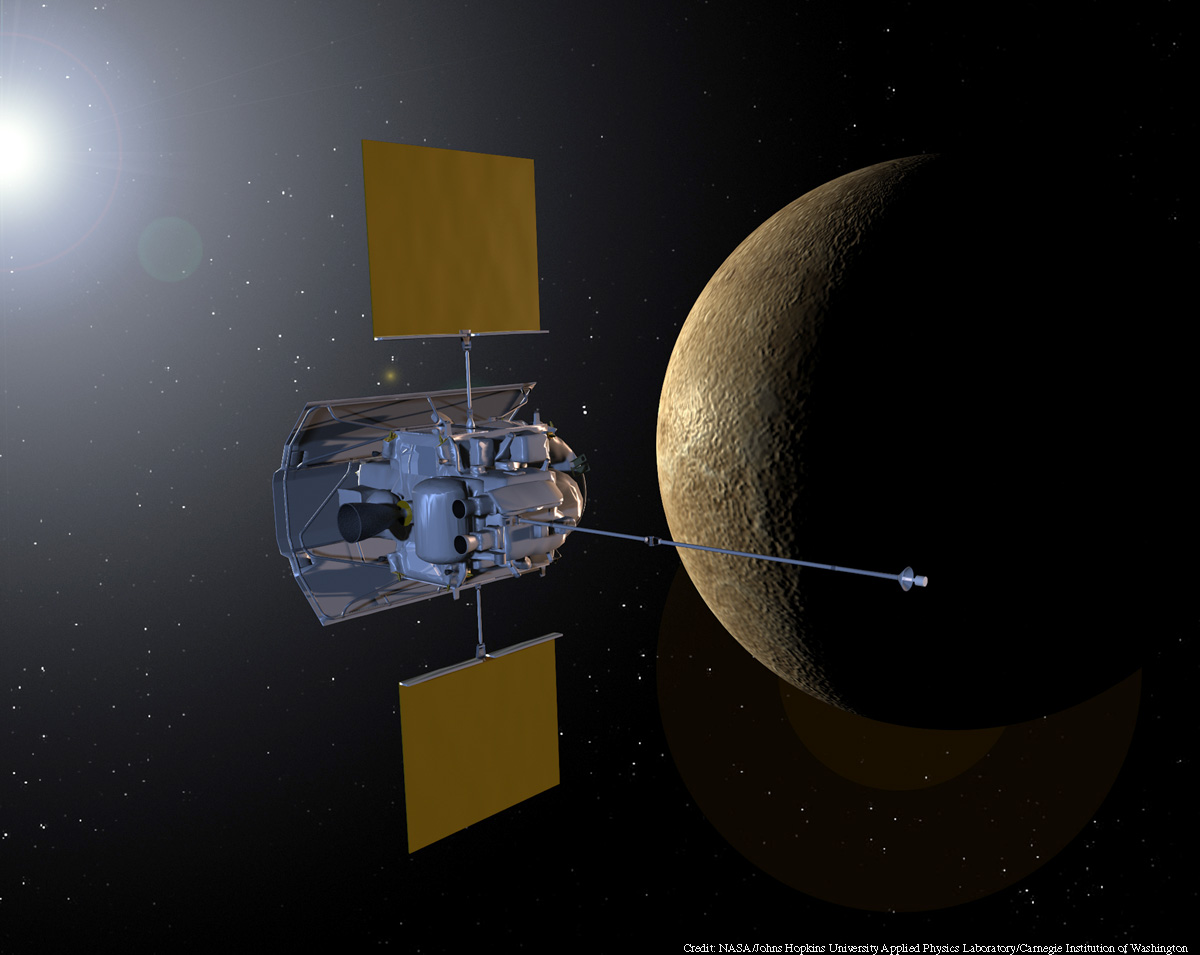
The MESSENGER spacecraft is a squat box (1.27 m x 1.42 m x 1.85 m) with a semi-cylindrical thermal shade (roughly 2.5 meters tall and 2 meters wide) for protection from the Sun and two solar panel wings extending radially about 6 meters from tip to tip. A 3.6 m magnetometer boom also extends from the craft. The total mass of the spacecraft is 1093 kg, 607.8 kg of this is propellant and helium. The structure is primarily graphite-cyanate-ester (GrCE) composite and consists of two vertical panels which support two large fuel tanks and two vertical panels which support the oxidizer tank and plumbing panel. The four vertical panels make up the center column and are bolted at their aft ends to an aluminum adapter. A single top deck panel mounts the LVA (large velocity adjust) thruster, small thrusters, helium and auxiliary fuel tanks, star trackers and battery.
Main propulsion is via the 645-N, 317-s bipropellant LVA thruster, four 22-N monopropellant thrusters provide spacecraft steering during main thruster burns, and ten 4-N monopropellant thrusters are used for attitude control. There is also a reaction-wheel attitude control system. Knowledge for attitude control is provided by star tracking cameras, an inertial measurement unit, and six solar sensors. Power is provided by the solar panels, which extend beyond the sunshade and are rotatable to balance panel temperature and power generation, which provides a nominal 450 W in Mercury orbit. The panels are 70% optical solar reflectors and 30% GaAs/Ge cells. The power is stored in a common-pressure-vessel nickel-hydrogen battery, with 11 vessels and 2 cells per vessel.
Communications are in X-band with downlink through two fixed phased-array antenna clusters and uplink and downlink through medium- and low-gain antennas on the forward and aft sides of the spacecraft. Passive thermal control, primarily a fixed opaque ceramic cloth sunshade, is utilized to maintain operating temperatures near the Sun. Radiators are built into the structure and the orbit is optimized to minimize infrared and visible light heating of the spacecraft from the surface of Mercury. Multilayer insulation, low conductivity couplings, and heaters are also used to maintain temperatures within operating limits.
Five science instruments are mounted externally on the bottom deck of the main body: the Mercury Dual Imaging System (MDIS), Gamma-Ray and Neutron Spectrometer (GRNS), X-ray Spectrometer (XRS), Mercury Laser Altimeter (MLA), and Atmospheric and Surface Composition Spectrometer (MASCS). The Energetic Particle and Plasma Spectrometer (EPPS) is mounted on the side and top deck and the magnetometer (MAG) is at the end of the 3.6 m boom. Radio Science (RS) experiments will use the existing communications system.
Alternate Names
- Mercury Surface, Space Environment, Geochemistry and Ranging
- urn:nasa:pds:context:instrument_host:spacecraft.mess
- 28391
Facts in Brief
Launch Date: 2004-08-03
Launch Vehicle: Delta II 7925
Launch Site: Cape Canaveral, United States
Mass: 485.2 kg
Nominal Power: 450 W
Funding Agency
- National Aeronautics and Space Administration (United States)
Discipline
- Planetary Science
Additional Information
Questions and comments about this spacecraft can be directed to: Dr. David R. Williams
Personnel
| Name | Role | Original Affiliation | |
|---|---|---|---|
| Prof. Sean C. Solomon | Mission Principal Investigator | Carnegie Institution of Washington | scs@dtm.ciw.edu |
| Dr. Edwin J. Grayzeck, Jr. | Program Scientist | NASA Headquarters | Edwin.J.Grayzeck@nasa.gov |
| Dr. Louise Prockter | Deputy Project Scientist | Applied Physics Laboratory | louise.prockter@jhuapl.edu |
| Mr. Brian Jay Anderson | Deputy Project Manager | Applied Physics Laboratory | anderson@ampvx2.jhuapl.edu |
| Dr. Peter D. Bedini | Project Manager | Applied Physics Laboratory | bedini@umich.edu |
| Dr. Ralph L. McNutt, Jr. | Project Scientist | Applied Physics Laboratory | ralph_mcnutt@jhuapl.edu |
| Dr. Robert W. Farquhar | Mission Manager | Applied Physics Laboratory |
Selected References
- Solomon, S. C., et al., The MESSENGER mission to Mercury: scientific objectives and implementation, Planet. Space Sci., 49, No. 14-15, 1445-1465, doi:10.1016/S0032-0633(01)00085-X, Dec. 2001.
- Gold, R. E., et al., The MESSENGER mission to Mercury: scientific payload, Planet. Space Sci., 49, No. 14-15, 1467-1479, doi:10.1016/S0032-0633(01)00086-1, Dec. 2001.
- Santo, A. G., et al., The MESSENGER mission to Mercury: spacecraft and mission design, Planet. Space Sci., 49, No. 14-15, 1481-1500, doi:10.1016/S0032-0633(01)00087-3, Dec. 2001.
- Solomon, S. C., et al., MESSENGER Mission Overview, Space Sci. Rev., 131, No. 1-4, 3-39, doi:10.1007/s11214-007-9247-6, Aug. 2007.
- Leary, J. C., et al., The MESSENGER Spacecraft, Space Sci. Rev., 131, No. 1-4, 187-217, doi:10.1007/s11214-007-9269-0, Aug. 2007.
- McAdams, J. V., et al., MESSENGER Mission Design and Navigation, Space Sci. Rev., 131, No. 1-4, 219-246, doi:10.1007/s11214-007-9162-x, Aug. 2007.
![[MESSENGER Mercury Image]](http://nssdc.gsfc.nasa.gov/planetary/image/messenger_mercury_flyby2_1.jpg)
![[MESSENGER Mercury Image]](http://nssdc.gsfc.nasa.gov/planetary/image/messenger_flyby1.jpg)
![[MESSENGER Diagram]](http://nssdc.gsfc.nasa.gov/planetary/image/messenger_diagram.jpg)
Mercury Fact Sheet
NASA's Discovery Program
Mariner 10 - Mission to Mercury (1973)
Bepi-Colombo mission to Mercury
Press Release on selection of MESSENGER - 7 July 1999
Press Release on launch of MESSENGER - 3 August 2004
MESSENGER Completes Venus Flyby - 24 October 2006
MESSENGER Completes Second Venus Flyby - 5 June 2007
NASA Reveals New Discoveries From Mercury - 3 July 2008
NASA's MESSENGER spacecraft returns to Mercury - 1 October 2008
MESSENGER Reveals More "Hidden" Territory on Mercury - 29 October 2008
MESSENGER Team Prepares for Third Flyby - 16 September 2009
MESSENGER Gains Critical Gravity Assist for Mercury Orbital Observations - 30 September 2009
MESSENGER Primed for Mercury Orbit - 15 March 2011
MESSENGER Finds New Evidence for Water Ice at Mercury's Poles - 29 November 2012
MESSENGER Project Home Page - JHU APL Images credit NASA/Johns Hopkins Applied Physics Laboratory/Carnegie Institution of Washington Planetary Science Home Page
![[USA.gov]](/logo/usagov_logo.gif)
